Thursday, 14 October 2010

TALKIN' 'BOUT MY BEAT GENERATION


I was asked a few questions by a glossy Italian style magazine a while back for an article about the Beat Generation. I’m still waiting to be flown to San Francisco for the photo shoot of me sagely thumbing the paperbacks in City Lights or supping a beer in Vesuvio’s with The Subterraneans casually placed on the bar.

Why do you think there’s an ongoing fascination with characters like Ginsberg, Kerouac etc?
They were groundbreaking in their writing; shaking up the staid, conservative, dull and frightened America. They looked it dead in the eye and challenged it. That alone would be enough but when you discover further controversy, court cases, links to the criminal underworld, prostitution, homosexuality, mental illness, lobotomies, murder, suicide, mysterious deaths, firearms, alcohol abuse, drug experimentation and addiction, travel, religion, wife sharing and bigamy, you’ve all the ingredients of a fantastic soap opera that continues to develop with every new publication of their correspondence (see the recent Jack Kerouac and Allen Ginsberg: The Letters).

Were the Beats perhaps more a cult than anything else?
For me, the Beats were solely Allen Ginsberg, Jack Kerouac, William Burroughs and their close associates – nothing to do with the cartoonish Beatniks that followed. The Beat Generation term came from a drunken Kerouac which Ginsberg was savvy, passionate and generous enough to use as the means to get his friends published in the aftermath of Howl. There’s little stylistically to link Howl, On The Road and Naked Lunch so it’s difficult to categorize them as a genuine literary movement; really they were/are a media phenomenon – even if they created it themselves.

Do they have a true legacy when it comes to poetry and literature?
They do, but time is dusting over the tracks of that legacy. The obscenity trials of Howl and Naked Lunch paved the way for greater freedom of expression and people like City Lights publisher Lawrence Ferlinghetti shouldn’t be forgotten in all this. They made poetry and literature exciting, even dangerous. On The Road reads somewhat quaintly these days but the rhythm and phrases in Howl, exploring and questioning the soul of America, could be hip hop lyrics of today and if Naked Lunch was published tomorrow its nightmarish visions could scarcely be any less powerful.

What are you expecting from the Howl film? Do you think Coppola’s On The Road project is a good idea (what I mean is, can you really hope to capture the essence of the book on film etc?).
From the short trailer, I can’t wait to see Howl . Visually looks spot-on, Franco looks convincing, a gripping courtroom drama and the greatest poem of the 20th Century. Looks like a winner to me. On The Road is a harder task to pull off. I can’t see any film doing the book justice but I’m not precious about it; it’ll come out and be forgotten just as quickly whereas Jack’s novel will continue to be read for another fifty years.

Wednesday, 13 October 2010

LENNY BRUCE - ALL ALONE

Another clip to watch. This one of Lenny Bruce who would've been 85 today. Well worth a watch. Funny yet sad. We've all been there.

Sunday, 10 October 2010

SOLOMON BURKE - "NONE OF US ARE FREE" (2002)

Solomon Burke, the King of Rock and Soul, died today aged 70.

Here he is in fine fettle back in 2002. Respect.

Thursday, 7 October 2010

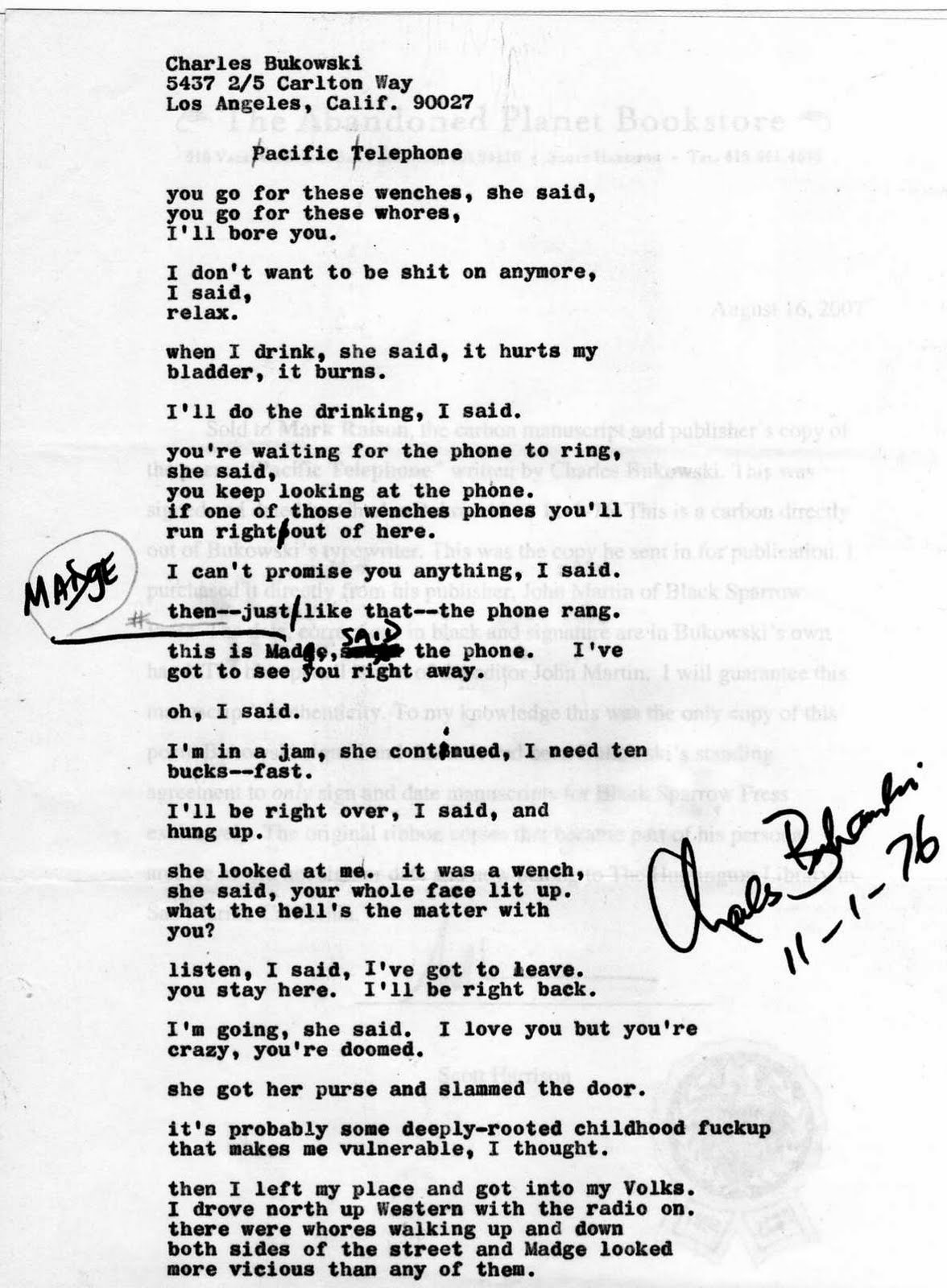
NATIONAL POETRY DAY: "PACIFIC TELEPHONE" by CHARLES BUKOWSKI


Today, apparently, is National Poetry Day. I’ve no idea what it involves nor do I care, but it's a good excuse to share one of my most treasured possessions with you that hangs proudly from the marbled walls of Monkey Mansions.

Above (click on it) is the original manuscript straight out of Charles Bukowski’s typewriter of “Pacific Telephone”. As you can see he wrote it on 1st November 1976, signed it, and posted it to his publisher John Martin at Black Sparrow Press. It appeared in Love Is A Dog From Hell the following year. The black pen marks are by Bukowski and the pencil marks by Martin.

It is so typically Bukowski and you can hear him so clearly reading in that slow lazy drawl and then adopting the whiney voice he used whenever speaking on behalf of the women in his life.

Bet old Hank would’ve loved National Poetry Day…

Wednesday, 6 October 2010

Sunday, 3 October 2010

RICHARD by BEN MYERS


“Most of my heroes don’t appear on no stamps.” Someone (Chuck D) said it, the Manic Street Preachers quoted it, and I pinched it. It’s a recurring theme.

I wouldn’t say I’ve any heroes as such but I wouldn’t deny The Jam, and Paul Weller in particular, musically and sartorially shaped my early teenage years and a decade later the Manic Street Preachers, and Richey Edwards in particular, had an equally profound and lasting effect ideologically and culturally.

The streets were covered with snow in January 1991 when I bought, unheard, the Heavenly 12 inch of “Motown Junk”. Time hasn’t diminished the thrill and rush of that garbled punk urgency which flew acid in the face of everything around it, then and now. It’s difficult for newcomers now with the Manics far removed from the mess of eyeliner and spray paint that first dazzled from the pages of the NME spouting off about William Burroughs, Karl Marx and Harold Pinter to believe how vital and exhilarating they were in an flimsy era of post-baggy "we've always had a dance element to our music" desperation and faceless shoegazing dullness. The Manics were a fascinating, intelligent, well read, educated, cynical, unfashionable, working class band kicking against the pricks, yet slowly – and frustratingly – unraveled as often willfully subservient and compromising.

Ben Myers’ Richard tells two stories in parallel. The first recounts the story of four insular school friends from a Welsh mining town that became the Manic Street Preachers who invited and provoked hostility and adoration in equal measures. Edwards, with little to no musical ability being enlisted because he was their best friend, driver, looked fantastic, balanced the symmetry, could write lyrics and be their Minister of Information a la Public Enemy’s Professor Griff. It proved a smart move but one that came at a price. There’s little in Myers’ imagining to cause too much indignation from Richey acolytes, as it effectively blends established “fact” with Richey’s well documented sense of worthlessness. After only selling a handful of their first homemade single Richey was already saying “There is more self hate in this band than anyone can realise. We hate ourselves totally”. Yeah, yeah, nice quote mate, makes good copy for the music press, play the game. Prove it they said.

The second, potentially more difficult to accept book, is the one told in Richey’s voice from the time he disappeared from the Embassy Hotel in 1995 never to be seen again. Myers uses the few alleged sightings as stepping stones to construct a version of events and a version of what could have been going through his mind. How would he know? Well, he doesn’t, does he? The book jacket pointedly says Richard - A Novel, not Richey Edwards - The Unauthorised Biography. It paints a distressed Richard driving on autopilot back to Wales, trampling the hillside, seeking solitude and release from the taunting voices in his head telling him what an insignificant, useless coward he is. Kurt Cobain, he proved it. He was 4 Real.

Myers was always going to court controversy with this (“how very dare he?”) and the technique has been done better before (David Peace’s The Damned United) but I managed to easily separate fact from fiction. Richey fans should be an intelligent bunch but that didn’t stop the clatter of protest before publication. If somebody had done the same to a personal friend of mine my instinct would be to want their severed hand on a stick but I didn’t know Richey; I only canonized my own interpretation of him. The interpretation based on his interviews and lyrics so I struggled through the first third of this book as I couldn’t hear Richey’s voice. The words attributed to him are at times simple and clichéd, as is some of the text, and not as eloquent and as carefully measured as I’d expect. But that slowly sinks away and the comparisons drift apart. I stopped reading it as an account dictated via Doris Stokes and started to appreciate it as a novel in its own right. It’s an increasingly uncomfortable and terribly sad read (and I’m certain no bundle of joy to write) but its contemplation on misery and confusion, alienation and despair, self loathing and suicide are surely food and drink for followers of Richard James Edwards.

Richard by Ben Myers is published by Picador, priced £12.99.

Friday, 1 October 2010

MAVIS STAPLES - "YOU ARE NOT ALONE" (2010)

The magnificent Mavis Staples has a new album out. It’s mighty fine, as is this acoustic version of the title track.