Showing posts with label james brown. Show all posts

Friday, 29 September 2017

SEPTEMBER PLAYLIST


1.  Claude Huey – ‘Feel Good All Over’ (1966)
On the flip of this sparse but effective soul shuffler is ‘The Worst Thing A Man Can Do’ which, according to Claude, is taking the love of a good woman for granted which displays a disappointing lack of imagination. Still, I’ll forgive him for ‘Feel Good All Over’.

2.  The Wrongh Black Bag – ‘Shake Me, Wake Me’ (1968)
A frantic version of Al Kooper’s Blues Project song and released as 4a 5 on Mainstream Records. On their way to the studio the band were involved in a car crash and the session cancelled, never to be rescheduled. Most unfortunate.

3.  The Lloyd McNeill Quartet – ‘Dig Where Dat’s At’ (1969)
Self-released in 1969, Asha has recently been reissued by the ever-dependable Soul Jazz Records. They refer to it as deep jazz and spiritual jazz, and it is, but it also includes this sprightly flute-led groover.

4.  Young Ladies – ‘I’m Tired of Running Around’ (1969)
Oh, Young Ladies, this is beautiful to groove to on a sunny afternoon.

5.  Curtiss Maldoon – ‘Man From Afghanistan’ (1971)
As I’ve said elsewhere, considering most of the tracks on a new 3-CD set, One Way Glass: Dancefloor Prog, Brit Jazz and Funky Folk 1968-1975, were made by blokes who thought teaming a vest with sandals as the height of dressing up, it’s one of the most rewarding collections I’ve heard for a long time. This track was a fairly arbitrary pick but when I checked the booklet for more info was delighted to discover the Curtiss Maldoon LP it came from featured most of Mighty Baby.

6.  James Brown – ‘Time Is Running Out Fast’ (1973)
From The Payback, this thirteen minutes of heavy rhythms sounds like JB attempting to outdo Fela Kuti at his own game. Irresistible. Check out the lyrics.

7.  Roy Ayers – ‘Aragon’ (1973)
From the soundtrack to Coffy, which stars Pam Grier as a nurse who murders a string of drug dealers in revenge for her sister getting hooked. "They call her 'Coffy' and she'll cream you!"

8.  Supergrass – ‘Richard III’ (1997)
The other day I bought The Best of Supergrass for the bargain price of one English pound. ‘Richard III’ may or may not have been about that bloke they found buried in a Leicester car park.

9.  The Oscillation – ‘Waste of Day’ (2015)
Bug-eyed Floydian psychedelic stew with a bassline that gets under the skin. A few trips around the mind to this is no waste of time.

10.  The Limiṅanas featuring Anton Newcombe – ‘Istanbul Is Sleepy’ (2017)
Moody French couple and the Massacre man wake ya from your dreams with a relentless vibrating noise to rattle the bed.

Friday, 13 May 2016

KILL 'EM & LEAVE: SEARCHING FOR THE REAL JAMES BROWN by JAMES McBRIDE (2016)


In 1966 James Brown released his new single ‘Don’t Be A Drop-Out’ which warned kids that “Without an education, might as well be dead”. Being James Brown he didn’t say it once but he said it loud, fifteen times.

The lyrics to JB’s R&B hits could be secondary to the main purpose of getting in his new bag, getting in the groove, getting ants in his pants and wanting to dance, but ‘Don’t Be A Drop-Out’, perhaps more than any other James Brown single – and I’m including ‘Say It Loud (I’m Black and I’m Proud)’ - got to the core message of Brother James, the Hardest Working Man in Show Business.

When Brown died forty years later he left a conservative estimate of 100 million dollars to educate poor children. It was a lifelong passion and a recurring theme through James McBride’s new book, Kill ‘Em & Leave: Searching For The Real James Brown which attempts to explain “the amorphous blend of black politics, culture, and music that helped shape the man.”

Who James Brown was depends on your standpoint. One right-wing UK newspaper recently described him as “a monster of greed and vanity, a bully, a tax-dodger on an industrial scale, a wife-beater and all-round maniac”. For James McBride he was “the greatest soul singer this country ever knew” and “arguably the most influential African-American in pop music history”. Brown could, possibly, be all those things but McBride writes as if presenting a case for the defence.

One early revelation comes that not one dime of the money Brown put aside has made it to help educate those children. A legislative battlefield has witnessed 47 lawsuits with lawyers, politicians, even family members munching on the “carcass and bones”, as McBride calls it, of Brown’s will. If there’s any money left now, there soon won’t be. The Man will have gobbled it up. Taken it.

The book’s most interesting parts are the events following his death and those at the beginning of his life which discover the roots of James Brown, his complicated family tree, and of growing up in the south - the poor south, the black south. From picking cotton and shining shoes, a teenage Brown was sentenced in 1949 for eight to sixteen years for four counts of breaking and entering (stealing cars and parts). He served three and half of those years and when released found the place he spent much of his childhood - Ellenton in South Carolina - is one of six small towns in South Carolina that had been cleared away by the government. Everything and everybody moved out, shattered to the wind, to make way for 310 square miles of the Savannah River Nuclear Site, the biggest bomb factory in the world.  

McBride surmises this played a part in Brown’s distrust in officialdom, which could take away anything they wanted, whenever they wanted. A young James had already seen family members leave, his liberty taken away and now whole communities wiped out. Whatever he obtained from now, he was going to keep. He sure as hell wasn’t going to trust a bank to look after his money. This, of course, would get him in a financial pickle later on. When the IRS came after him for 15 million dollars in taxes Brown claimed he was exempt because Richard Nixon had announced he was a national treasure and also that he was part Indian related to Geronimo. Nice try. Brown dealt in cash – up front – which he proceeded to hide: in suitcases, under the floorboards, buried in the garden, under trees, in hotels he stayed in on tour to which he would much later return. Brown took tight control over everything he did and woe betide anyone who crossed him.

It’s surprising therefore to hear Brown described as generous man but McBride is such a huge fan much journalistic impartially has been put aside. It’s written at times like a pulp detective story with McBride at the centre of the action. As a series of blog pieces it would work better but I don't care about McBride’s music career, his days as a student of journalism, his divorce, his repeated moans about young people wearing their pants around their asses and their caps back-to-front. When interviewing people I want to hear their stories not what they had to eat or the difficulty the author had finding somewhere to park his bike.

The interviewees, by and large, don’t have a great deal to offer. It’s nice to hear from the only survivor of the Famous Flames, guitarist Nafloyd Scott, but he has no fresh insight. He also, to his credit, has no axe to grind. Those who talk remain loyal to Brown preferring to say nothing than badmouth him. Charles Bobbitt, Brown’s personal manager for 41 years and there at his deathbed, chooses not to divulge much; Pee Wee Ellis, such an integral part of the classic JBs line-up, would rather not talk about his ex-boss; and Miss Emma, the wife of Brown’s close friend Leon Austin and the woman JB called “Sis”, when asked about the drugs, relationships with women, the beatings, the cruelty replies "I was taught you don't talk low on somebody. Especially if they're dead".  

On a more positive note, his relationship with Leon Austin dispels the perception - hardened in the Get On Up movie – that James Brown couldn’t do friendship, that he was alone as a man. Also, Brown’s first wife Velma speaks fondly of her ex-husband, the bond that remained between them, and of the shared agony of the death of their son Teddy, killed in a car crash. McBride concludes JB was “more southerner than he was black or white, more sensitive artist than he was superstar".

James Brown, whatever we think of him as an individual, is in a league of one when it comes to his music but this book says little about that. There’s a detailed and rounded biography to be written but this isn’t it. The New New Minister of the Super Heavy Funk is cast in a better light than sometimes afforded but he was a hard man to get to know. He was guarded, his defence built up, he kept his distance, he didn’t like to mingle. “Arrive important, leave important,” he would say. “Kill ‘em and leave, kill ‘em and leave”.

Whatever legacy James Brown left behind on Christmas Day in 2006 when his body finally collapsed it wasn’t the one he wanted: to help kids stay in school. He wouldn’t have felt good about that.

Kill ‘Em & Leave: Searching For The Real James Brown by James McBride is published by Orion Books, priced £20. 

Friday, 11 March 2016

THE WEEKEND STARTS HERE: JAMES BROWN, HYSTERICAL MODS, READY STEADY GO & HISTORIC WALTHAMSTOW SHOW (MARCH 1966)

James Brown, Ready Steady Go, 11 March 1966 (Photo David Redfern)
“There we were watching James Brown, the Famous Flames urging him back, his cloak laid on his back as he’s dragged to the centre of the stage– screaming, screeching, and we thought that this was it. Anything else was a distraction. We were bonded into a sweaty, sound drenched, sanctified brotherhood of S..O..U..L.”

Fifty years ago, on Saturday 12 March 1966, Barry Coidan witnessed the first ever UK concert by James Brown, a night forever etched in his memory and recounted on his . This historic occasion didn’t occur, as one might imagine, in a Central London venue but on the very outskirts of the capital in Walthamstow, E17, which had only merged into a London borough from Essex the previous year and accessibility via the Tube network was at least another 18 months away. Barry and his school friends - bonded in soul brother and sisterhood – who drove 80 miles from Brighton in a Ford Anglia to the Granada Cinema can be forgiven in feeling they were venturing into unknown territory, but even Adele T and her friend, who set off in a Mini (as in car definitely, skirt possibly), from north-west London had never heard of Walthamstow either.

“I know we drove through the West End to get to Walthamstow – no sat navs then – and somehow arrived at the Granada – buzzing with excitement and what a show – it was unbelievable,” recalls Adele. “I especially remember the end of the concert. James Brown on stage, his vocal group behind him, holding his gold and red cloak, trying to put the cloak on his back to lead him off stage – James Brown, kneeling on stage, not wanting to leave – the cloak thrown off, then put on again, then taken off again. The band playing – ‘You Don’t Have To Go’ - the group singing the words – James Brown kneeling yet again, then finally, after repeating this riff several times, the cloak finally around his shoulders and he walked off stage, only to return for another verse of the song – the climax of a wonderful performance - pure theatre, it was superb!”

The self-styled Mr Dynamite was in an explosive run of form when he hit the UK. Nearly ten years into his recording career ‘Papa’s Got A Brand New Bag’ began to rewrite the rules of song construction – changing the beat, stripping away chord changes and melody, creating funk - and gave Brown his first US Top 10 “Pop” (as opposed to “R&B”) hit and his first UK Top 30 hit in September ’65. ‘I Got You (I Feel Good)’ followed and was on the chart as Brown, Bobby Byrd, the Famous Flames, his 18-piece orchestra and entourage stepped off the plane at Heathrow on 9 March to be greeted by half a dozen fans with albums to sign and a gaggle of press photographers. Although ‘I Got You’ would only climb as high as number 29 his reputation and standing amongst those who dug a little deeper – especially the Mods – was sky high.
James Brown arrives at Heathrow, 9 March 1966
The Walthamstow appearance, in which Doris Troy also appeared on the bill, was preceded the night before by a special performance on Rediffusion TV’s Ready Steady Go! Always a huge supporter of visiting American artists, editor Vicki Wickham pulled out the stops for Brown and handed over the entire show (the 137th edition, fact fans) to their guest and his revue, the only time such an honour was afforded a single artist. A similar Otis Redding special in September included appearances from Chris Farlowe and Eric Burdon; whilst The Who only occupied the second half of their Ready Steady Who edition in October (Georgie Fame and Lee Dorsey filling the first half). 

Regretfully no footage of Brown as he muscled into living rooms across the nation as the youth started their weekend has survived although at least one JB collector claims to own an audio recording (my enquiries so far have been met with stony silence). RSG’s director, Michael Lindsay-Hogg, explained the loss to The Guardian: "Most of the shows were wiped because tape was so expensive, so stuff like the James Brown special and The Who special are gone forever. I took home £37 a week but, every so often, I'd buy a video tape and preserve it. It cost me £1 a minute, but the only reason any shows survive is because I did that."  

Prior to the show Brown gave the producers some twitchy moments. Vicki Wickham: “Michael Lindsay Hogg and I went to meet him at his hotel where he adamantly told us he didn’t rehearse.  He said it would like asking a footballer to play the game before game time! He came to the studio and we were nervous but once Michael showed him the stage and the surface of the stage we’d built so that he could dance and do his routines his attitude changed and the sound-check was seamless and they ran through most of the show.  It turned out that he had done a BBC show the night before and they had him on a small riser and he was angry that he couldn’t dance or move.”

Not that Brown’s broadcast, which hit television screens at 6.08pm on Friday 11 March, was received with anything like universal acclaim as one review quoted in Jon Savage’s 1966: The Year The Decade Exploded makes clear. “If you have a taste for old-fashioned entertainment (primitive screaming and emotional kidology) done every bit as top-priced African witch doctors and the most famous minstrel shows, then don’t miss the Wild Man of Harlem.”
"Wild Man of Harlem", London, March 1966 (Photo by Harry Goodwin)
More surprising, although without the racist undertones, was the view of Ready Steady Go! presenter Cathy McGowan who laid it on thick for BBC’s The Story of Pop.  "When he came here he was hailed as the great James Brown – and the show was awful. I mean he just couldn't produce the sound. It was terrible. I mean it was really awful. It was a bad, bad show. A disaster. And the only reason that they devoted the whole show to Brown was because of the following that he'd got here built up because of the hysteria on the part of the Mods. You know, it was like everything else. It was like everybody's-gotta- say-you-like-James-Brown-week. So, of course, the demand for James Brown records was such that everyone was writing into the programme saying James Brown. Every Mod you asked would say James Brown. And the worst thing of all was that when he actually did his numbers the Mods didn't like him. The music and the records were so fantastic, but when they actually came there to the studio to do it live... something went."

It’s worth reading Brown scholar Cliff White’s eloquent rebuttal to McGowan and detractors in full but in part he writes, “Brown didn't so much appear on RSG as dominate an hour of television that just happened to fill the program's regular spot. He strutted and stamped and screamed, he sweated and grunted and fell on his knees (and screamed), he danced across the stage like he had skates on and then charged around the studio, through the audience, and back again (screaming). In short, he was quite uncontrollable, and he kept it up for the entire show, pouring out barely intelligible lyrics while his bloody great band hit chords that fractured nerves and hammered relentless riffs without mercy. All in all, he was quite magnificent.”

As White added, James Brown was neither Helen Shapiro nor “simply another harmless jigaboo with a trendy kind of rhythm and a humble smile”. This was indeed a new bag. So new it left audiences confused, especially by Brown’s famous cloak routine during ‘Please Please Please’ which, according to the popular press, left scores of television viewers appalled by his “disgusting behaviour”. The Daily Mirror leading the charge the next day claiming ‘Pop Singer’s Mock “Fits” Shock Viewers’. Epileptic seizures and religious reawakening were difficult to tell apart in 1966.

David London shared White’s assessment. “I worked on many of the RSG shows as a studio floor manager. My everlasting memory was of the then unknown great James Brown taking over the whole show and just leaving everybody absolutely speechless! Great memories.”

College friends of a Mod persuasion of one Walthamstow witness, Geoff, had another take. “I saw him when he first toured in the 60s, at Walthamstow Granada, absolutely brilliant, so good went back for the second performance, got in the second row from the front, I think the seats cost 30 shillings or something similar. His performance was magnificent, never seen anything quite like it, so well-rehearsed. At the time I attended day release at the London School of Printing at Elephant & Castle, and all the others in my class slagged off his appearance on Ready Steady Go! (which was very similar to his live show) as too rehearsed, lacking spontaneity, etc. But then they raved over the Action doing ‘I'll Keep Holding On’, so what did they know about soul music?”

For local Mods like Steve Ellis, singer with Tottenham band the Soul Survivors, the impact of witnessing Brown up close had a profound effect as he recounted in Paul ‘Smiler’ Anderson’s 2013 book, Mods: The New Religion. “Our manager, Sid Bacon, was forever telling us to go and see live bands. He got us tickets to see James Brown & the Famous Flames at the Walthamstow Granada. That night James Brown was fucking unbelievable. He absolutely blew my socks off. I came out after that gig and I just thought, ‘I’ve got to be like that. My God that’s how good I’ve got to be and that’s what I’ve got to do with this band’”. With his band’s name switched to Love Affair, Ellis scored a UK number in 1968 with ‘Everlasting Love’.

Eddy Grant from another North London band in attendance, the Equals, would similarly hit the top of the charts in ‘68 with his song ‘Baby, Come Back’. Eddy had no hesitation when asked in 2008 about the most memorable gig he’d attended. “That is quite easy. James Brown, live at the Walthamstow Granada in 1966. Nothing has beaten that since.”
Programme for Walthamstow & Brixton Granadas 
Although I rather unfairly implied the Walthamstow Granada was out in the back of beyond it did play host to most of the major acts in the 60s – the Beatles, the Rolling Stones, Johnny Cash, Roy Orbison, Small Faces, the Who etc – and had a long history dating back to the late nineteenth century when it served as a performing arts venue. In 1930 it was bought and modernised by Granada Theatres who turned it into a 2,697 capacity cinema that later also doubled as a concert hall but it took the boldness of promoter Arthur Howes to travel to the US and bring Brown to the Granada theatres (JB played Brixton the day after Walthamstow before heading to Paris) after bosses at rivals Top Rank ran scared.

“I’m always surprised by the staying power of old cinemas,” wrote Barry Coidan on his As I Was Saying To My Friend The Other Day blog. “Besides the massive trauma of James Brown’s brass, the old Walthamstow cinema shuddered to the sound of our unrestrained teenage voices, stomping feet and generalised sexual energy. The Scala, Shepherd’s Bush Empire, the Hammersmith Apollo, the Forum – lovely old cinemas – now unflinchingly absorb the kinetic energy of our age.”

After over a decade of sitting unused, and after tireless campaigning by local residents, the old Granada (EMD) Cinema building at 186 Hoe Street is open again. The former foyer now utilised as a pop-up bar, under the title Mirth, Marvel and Maud, whilst the rest of the Grade 2 listed building, including the auditorium where Brother James repeatedly smashed to his knees, is being developed to breathe new life into the burgeoning local arts community.

I was in there two weeks ago listening to DJs bang out old soul and funk records and it already looks gorgeous, mercifully keeping the character and much of the décor of the past. It was impossible to not think about James Brown and how fifty years previously Record Mirror had described gig goers exiting into the cold air with “ears ringing and apparently not working properly; eyes definitely out of focus; legs a trifle shaky”. I too suffered from some of those symptoms but not, unfortunately, due to the Godfather of Soul conquering new territory during one weekend in 1966.

POSTSCRIPT:

After publishing the above yesterday I received the following addition from Merric Davidson who runs the great Top 10 music site Toppermost. Not only did Merric attend the Walthamstow show but kept a press cutting too. Thanks a lot for sharing Merric.

"JB at Walthamstow Granada, Saturday 12 March 1966. Four of us travelled up from Bournemouth and afterwards took in a Les Cousins all-niter (another story). Certainly an event, much planning involved, we wore James Brown armbands made out of mauve corduroy if memory serves, and sauntered up Carnaby Street beforehand giving it some! It was an extraordinary evening, sitting in a cinema, quite a few rows back, and as soon as the band struck up we were all out of our seats and down the front, or as close to the front as we could get. I reckon it was a similar show "The TAMI Show" but the rapture took over right from the first note so it's hazy. Anyway here's Stan Laundon writing in The Independent (local paper, where based?) on 18 March 1966:

JAMES BROWN HITS THE GRANADA FANS BY STORM - When American rhythm and blues star James Brown appeared at Walthamstow Granada Theatre, Hoe Street, on Saturday, manager Mr Ralph Papworth, had full houses - and a night he will never forget. Brown, a brilliant showman and the biggest rage on the rhythm and blues scene for many years, spoke to me in his dressing room before the show: "My kind of show is different from the rest. I have something to offer and when I give it, I give it from my heart - I like to express my feelings." When James Brown walked on to the stage, the audience went wild. As the atmosphere in the auditorium mounted, Brown ran through a list of his well-known hits, including his latest disc, "I Got You, I Feel Good" - probably unheard by the screamers. Almost every agent in London had booked seats for their own artistes to watch the show, among them Dusty Springfield, Charlie Watts of the Rolling Stones, Peter Asher of Peter and Gordon, Millie and many others who either entered the show late to avoid suspicion or in disguise. Fans stood in the aisles, climbed on the seats and even tried to rush the stage just to get a glimpse of the famous James Brown and his group, the Famous Flames. Brown, 32, was slammed by the nation's newspapers for doing a "fit" on the Granada stage, purely for a little extra showmanship. The remainder of the bill was the Mike Cotton Sound, the Marionettes, Doris Troy, and compere Keith Fordyce."

Can't remember any of that first half with those guys and I'm glad I can't remember Keith's "urgings" but the second half from the great man, a memory for life!"

Sunday, 30 August 2015

AUGUST PLAYLIST


1.  Champion Jack Dupree – “Bad Whisky and Wild Women” (1963)
Plenty bluesmen were convinced bad whisky and wild women would be the death of them. Were they bothered? Were they ‘eck as like. Dupree lived into his 80s, so there’s probably a lesson there somewhere.

2.  Dorothy Berry – “Ain’t That Love” (1964)
“You Better Watch Out” receives a few club spins but I’ve always preferred this more raucous flip which kinda sounds like a rhythm and soul take on garage punk.  

3.  Bob Dylan – “Desolation Row” (1965)
There’s Bob Dylan, then there’s everybody else. Seeing how Highway 61 Revisited was released 50 years ago today it’s only right to pick a track.

4.  Jimmy Smith – “Is You Is Or Is You Ain’t My Baby” (1968)
Jimmy could never claim his vocals were his strong point and the title of his 1968 album Stay Loose… Jimmy Smith Sings Again almost reads like a warning but it’s great fun with the organ maestro growling like a playful bear having his tummy tickled.

5  Merle Haggard – “White Line Fever” (1969)
“This one’s for all the truck drivers,” says Merle in his introduction before singing “White line fever, the years keep flying by like high line poles”. The version by the Flying Burrito Brothers is fantastic too, even if Gram Parsons implied a very different type of flying.

6.  Eugene McDaniels – “Jagger The Dagger” (1971)
Gene McDaniels was a long way from “Hundred Pounds of Clay” when he cut a couple of breakbeat-heavy albums for Atlantic: Outlaw followed by Headless Heroes of the Apocalypse which contained the circling menace of “Jagger playing a heavy game/ Free from guilt and he's free from shame/ Jagger sucking the source of life/ Slashing the pig with a horny knife.”

7.  Rod Stewart – “(I Know) I’m Losing You” (1971)
It’s unfortunate one of The Faces finest tracks and highlights of their live shows didn’t feature on one of their own albums but slunk onto Rod’s Every Picture Tells A Story instead. No matter, they soak the angst of the Temptations and in brandy and come out rattlin' and rollin', turning a loss into a gloating triumph.

8.  James Brown and Lyn Collins – “What My Baby Needs Now Is A Little More Lovin’” (1972)
This always strikes me as a bit of an oddity as Mr Brown and Ms Collins engage in a surprisingly light and nimble, piano tinkling duet. Very good though.

9.  Vic Godard – “Johnny Thunders” (1992)
I’m not sure if Subway Sect ever played on the same bill as the Heartbreakers but it’s quite possible. Either way, this 45 for Rough Trade’s Single Club saw Godard pay tribute in suitable style to Thunders, who’d died the previous year. Paul Cook drums.

10.  Captain America – “Flame On” (1992)
Post-Vaselines Eugene Kelly formed Captain America and their Scottish pop-grunge-stew was all the rage for five minutes until their Flame On EP landed them in bother with Marvel Comics for their name and, from memory, clothing chain C&A for pinching their logo. Under the title Eugenius they survived longer, signing – inevitably – to Creation but this song is the one which best recalls the lank-haired, oversized t-shirt wearing, floppy indie disco pint sploshing dance of the time. Admittedly that might not sound like a great incentive to check it out.  


Tuesday, 7 April 2015

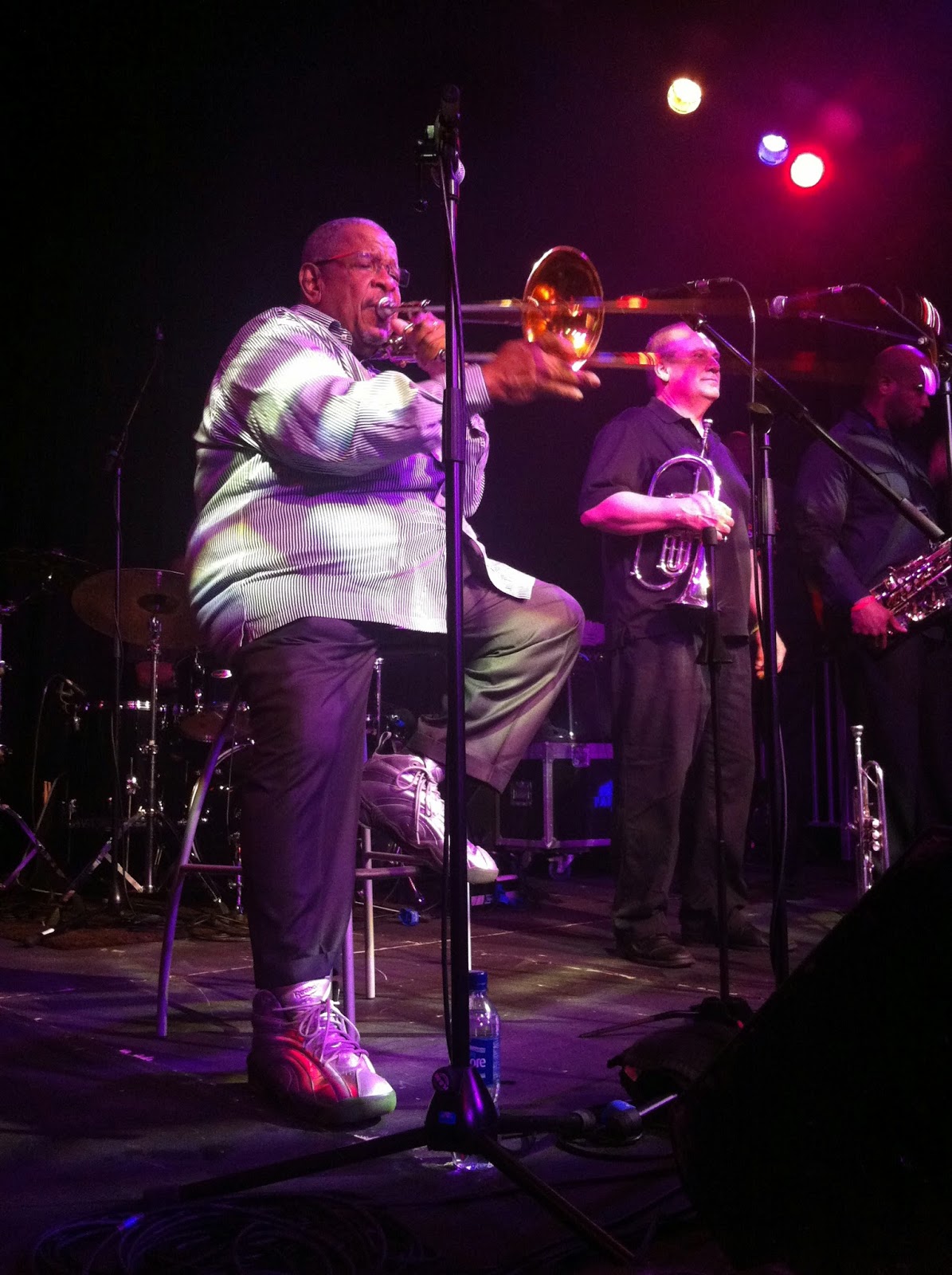
FRED WESLEY & THE NEW JB’S at STAND!, FAIRFIELD HALLS, CROYDON


There’s nothing like having a quick nosey at Fred Wesley’s discography to make one wonder what they’ve done with their life. As musician, band leader, arranger, composer and producer Fred has shaped the sound of funk on hundreds of recordings with James Brown, the JB’s, Bootsy’s Rubber Band, Parliament, the Horny Horns and many, many more.

In his 2002 autobiography, Hit Me, Fred: Recollections of a Sideman, Wesley calls himself “the greatest sideman in the world” – which in fact underplays his contribution, he isn’t just a horn player - but now he’s centre stage, perched on a stool, master of his own small but perfectly formed empire.  The moment he blows his trombone the sound is as instantly recognisable as a JB scream or a Bootsy Collins bass run. Fred Wesley only doesn’t have the funk, he is the funk. His New JB’s aren’t new anymore, this current line-up has mostly been in place many years and it shows in their tight groove.

The JB’s classic “Damn Right I Am Somebody” underlines Fred’s a man in his own right; “Bop To The Boogie” is an early invitation for audience participation - “Bop to the boogie, boogie to the bop, bop to the boogie, bop bop” - which looks ridiculously easy written down yet many (or maybe only me with my stiff honky ways) fail to master; there’s Fred’s favourite track from the Horny Horns 1977 LP A Blow For Me, A Toot For You – “Fourplay”; Fred takes a lead vocal on Earl King’s “Trick Bag”; and Dwayne Dolphin takes a bass solo in “No One But You Baby” as his boss looks on and appreciates with a knowing nod. No sign of any fine for bum notes or clumsy dance steps.

The line between jazz and funk is thin one and on that line sits jazz-funk, which always strikes me as the musical equivalent of a lager-top: a less satisfying, watered down, compromise. Well, that's my take; I can't warm to it. There are a few numbers which epitomise jazz-funk and the audience get a little distracted during the one love song and shout for “Pass The Peas”. Don’t worry, says Fred, it’s coming. He’s been around long enough to know how to pace a show and bring it to the boil.

“Breakin’ Bread” from the first Fred Wesley and the New JB’s album is an odd song - early rap with a hint of country funk - but gets folk involved once more and leads into the final run of three massive JB’s tunes: the aforementioned “Pass The Peas”, “Gimme Some More” and “Doing It To Death”. These are what the crowd came for and they burst back into life as if transported back into the midst to the late-80s Rare Groove explosion when these tracks caught a second wind and became some of the biggest club tunes around. Fred has small pocket of south London tightly in his control as people are movin’, groovin’, doin’ it. To quote again from Hit Me, Fred: “The black people were dancing very well, as usual, and the white people, as usual, were enthusiastically doing the best that they could do.” Thank you Mr. Wesley. 

Sunday, 1 March 2015

MR DYNAMITE: THE RISE OF JAMES BROWN (2014)

Sat in front of the gogglebox last night, imagine my surprise and delight when BBC2 screened Alex Gibney's 2014 documentary, Mr Dynamite: The Rise of James Brown. What a brilliant film. Loads of rare footage (I regular scour the internet and there was plenty new to me), archive and new interviews, band members doing funny impressions of their leader, insight, context, the lot. If you missed it, or want to watch The Hardest Working Man In Show & Business repeatedly, it's available on the BBC iPlayer for the next month. Get up, get into it, get involved.

Sunday, 27 July 2014

JULY PLAYLIST


1.  Yusef Lateef – “Psychicemotus” (1965)
Most hipsters were still a couple of years away from psyching everything in sight but by 1965 saxophonist and flautist Lateef had been expanding minds for years with his Eastern infused jazz. I’ve only recently scratched the surface (there’s much digging to be done in Lateef’s vast catalogue) but the few albums I’ve got - Eastern Sounds (1961), Psychicemotus (1965) and Yusef Lateef’ Detroit (1968) - are all different but all great. This track, with its bamboo flutes and sparse complex rhythms, is Moondogtastic.  

2.  The Turtles – “Outside Chance” (1966)
Saturday mornings always begin with Brian Matthew’s Sounds of the 60s show on Radio 2. Yesterday he played this fantastic folk-punker.

3.  Dick Wagner and the Frosts – “Sunshine” (1967)
Debut single from Detroit area rockers Michigan rockers The Frost was a suitably groovy and thinly veiled ode to the lysergic stuff. 

4.  Bobby Womack – “Tried and Convicted” (1968)
Bobby was due to play in Walthamstow this weekend but he got the call from soul heaven so went there instead. Bit of an extreme measure to avoid E17; we might not have a 110th Street but we do have a Hoe Street.

5.  James Brown – “Just Enough Room For Storage” (1971)
The instrumental album by the James Brown Band, Sho Is Funky Down Here, is more of a surprise than one might expect. There’s a funky jazz groove on the title track but what makes the record an oddity is all tracks are co-written credited to James Brown and Dave Matthews. JB never one to give credit (and royalties) lightly, it has to be assumed the vast majority of the work was by arranger Matthews, and that certainly comes across with acid rock guitar leads unlike anything else associated with Brown.

6.  Clydie King – “’Bout Love” (1972)
Although Clydie King is one of countless singers to never really “make it” – earning her crust in the shadows as a backing singer – she’s one of the more unlikely examples. Her vocals on ’65-’66 singles for Imperial – “Missin’ My Baby”, “If You Were A Man”, “Soft And Gentle Ways” etc – are knee-tremblingly  gorgeous and she looked stunning. Her recording career stretched back to 1956 but Clydie had to wait until 1972 to cut Direct Me, the first of only two solo albums, which included the rather pertinent “Ain’t My Stuff Good Enough?” and this glittery stomper.

7.  Billy Swan – “Don’t Be Cruel” (1975)
The new Country Funk II compilation is every bit as good as the first volume. A swampy mix of late 60s and early 70s countrified soul and funk opens with Billy Swan taking “Don’t Be Cruel” at a stoned alligator pace but accompanied by a dope breakbeat. Yes, I’ve just typed dope breakbeat without really knowing what one is. Dig that crazy rhythm. Groovy. Wicked. Whatever.

8.  The Jetset – “Wednesday Girl” (1984)
The Jetset were South London’s maraca shaking, striped hipster wearing, Jetsetmobile driving version of The Monkees as you can see here on Spanish TV.

9.  St. Paul and the Broken Bones – “I’m Torn Up” (2014)
Paul Janeway might look like Alan Carr but, thank the Lord, sounds more like an overwrought James Carr. Alabama born, he and his Broken Bones mixed their debut, Half The City, in Muscle Shoals and not only does Janeway’s possess an amazing voice there appears to be a genuine understanding and love of soul music in the groove. The majority of these new/old soul combos leave me cold but for the most part Half The City positively smoulders.  

10.  Manic Street Preachers – “Europa Geht Durch Mich” (2014)
Futurology isn’t the masterpiece some have claimed but it’s still very good and easily the best Twelfth Album Of A Career a band has ever made.

Sunday, 5 January 2014

JAMES BROWN ON THE DAVID FROST SHOW (1970)

When James Brown appeared on the David Frost Show in 30 March 1970 he was rather obviously courting the white vote as he schmaltzed (JB style) through covers of “By The Time I Get To Phoenix”, “What Kind Of Fool Am I?”, “Georgia On My Mind” and a duet with Vicki Anderson on “Let It Be Me”. His current album Soul On Top followed a similar theme with jazz standards, middle of the road numbers and even a Hank Williams tune. Three weeks after recording the Frost Show, James was in the studio, back on the good foot, recording “Sex Machine”.

By his own admission Brown was now 25% artist and 75% businessman and although he looked after Soul Brother Number 1 first, he gives a good account of himself to Frost, touching on how his radio stations help communities and how - exasperated by those getting fat of the land whilst poor people suffer – he was issuing James Brown Food Stamps to the poor in the cities he played. It’s entertaining to watch Frost struggle to communicate with Brown but JB’s message of “If everybody gets their shoulders together and push, we can accomplish something here, so let’s do it” is loud and proud.


Wednesday, 19 June 2013

CHARLES BRADLEY at the ISLINGTON ASSEMBLY HALL


If there’s something soul fans like more than heartache, misery and pain, it is heartache, misery and pain followed by survival and reward. No wonder Charles Bradley has been taken to our collective heart.

As Poull O’Brein’s fly-on-the-wall documentary, Charles Bradley: Soul of America, shows (and by the way, that was just dust in my eye, okay), Charles had to wait until he was 62 to release his first album, No Time For Dreaming, in 2011. He also suffered the murder of his brother, nearly died himself, lived hand-to-mouth in the tough housing projects of Brooklyn earning money as a James Brown impersonator, until hooking up with - and being gently nurtured by - Daptone Records who helped reveal his true self, previously hidden beneath the supportive crutch of a JB wig and cape. The film ends with his debut album being acclaimed as one the best 50 of the year by Rolling Stone magazine.

This heart-warming back story would only stretch so far if Bradley couldn’t take care of business. His second LP, the recent Victim of Love, is an improvement on the first – more assured, more natural, more cohesive - and to a sold out Assembly Hall he sho’ nuff TCB. Backed by an excellent young band (billed as The Extraordinaires but looked to me like the Menahan Street Band who played on his records) he delivered a performance with all the trappings of classic soul show.

The band hit a couple of instrumental warm-up numbers (including a funky version of the Lovin’ Spoonful’s “Summer In The City”) before Charles was given a ratchet-raising introduction: “Ladies and gentlemen…The Screaming Eagle of Soul… Miiiister… Chaaarles…  Braaaaaadley!” Out he strode in a white and glitter suit, black shirt, and straight into “Love Bug Blues”, one of the more overtly early-mid 70s James Brown work outs with a few moves thrown in straight from the Godfather’s manual.

Bradley has two main styles: the James Brown one used on “Confusion” and “Where Do We From Here” and a deeper, bluesier one (used more often) on “Through The Storm” and “How Long”. To his credit CB uses the JB moves sparingly. They are still there but he’s his own man and adopts them no more than his more illustrious predecessors in the soul and funk field who also copped plenty from Brown and Jackie Wilson.

There’s a couple of costume changes (nice take on Del Shannon’s “Runaway” in the meantime); some rather off-putting moments when he does a luurveman routine licking his finger and putting it to his sizzling bare belly; a far more impressive move where he flaps his arms gracefully like an eagle coming in to land; and during “You Put The Flame On It” he demonstrated so many dances and off-the-wall shapes in quick succession I thought I was watching David Brent auditioning for Berry Gordy.

No soul show would be complete without being asked “Do you want to go to church?” and the tear-jerking ballad “Crying In The Chapel” was immense. He hasn’t got a perfect voice (thankfully); it’s less whisper to a scream, more yell to a strain, but the roughness brings raw soul straight from his massive heart. 

Sunday, 28 October 2012

OCTOBER PLAYLIST


Popular spins in Monkey Mansions this month include:

1. Grant Green – “Have You Ever Had The Blues?” (1963)
Guitarist Green may have had top billing but Big John Patton’s Hammond takes centre stage. Taken from the excellent Blues For Lou LP which incredibly had to wait 36 years before release.   

2. The Action – “Why Do You Wanna Make Me Blue” (1965)
Talk about unearthed treasure. This was the audition disc The Action cut for Decca on 31st May 1965 and the earliest evidence of their brilliance. They attack The Temptations at quite a lick but once they settle down it has everything we’d come to know and love from our Kings of Kentish Town: Reggie King’s passionate vocal, the three-part harmonies and the chiming guitars. Only available as part of the deluxe edition of the In The Lap of The Mods book which is utterly essential. Full review to follow.

3. Clarence Carter – “Snatching It Back” (1969)
The sound of Muscle Shoals. The whole Testifyin’ album is a bristling soul cracker.  

4. Tony Joe White – “The Daddy” (1971)
Can’t help but think of Stanley Road era Paul Weller. But don’t let that put you off.

5. James Brown – “It’s A New Day” (1970)
“Hair is the first thing. And teeth the second. Hair and teeth. A man got those two things he’s got it all.” – James Brown.

6. The High Llamas – “Checking In, Checking Out” (1993)
With the vogue for bands marking anniversaries by performing “classic” albums, I’m hopeful The High Llamas will play Gideon Gaye next year, for it’s an album worthy of such an accolade.    

7. Andy Lewis featuring Keni Burke – “(Love Is) Alive In My Heart” (2005)
The best soul-pop song The Style Council never made.

8. Tame Impala – “Feels Like We Only Go Backwards” (2012)
Second album Lonerism works best as a whole rather than piecemeal but the revolving psychedelic glitterball of “Feels Like We Only Go Backwards” is a typical of its giddy feel.

9. The Urges – “Fire Burning” (2012)
Irish bowlheads add a touch of brass to this frantic and infectious Whiskey-A-Go-Go-esque club shaker.

10. Andre Williams – “Stuck In The Middle” (2012)
Since the mid-50s Williams has been around the musical block and in some dark alleys but he’s back in Detroit and in good shape on his new LP, Life. Opener “Stuck In The Middle” is the best track with Andre’s trademark laconic vocals set against a bar-band Funkadelic groove.      

Saturday, 27 August 2011

FREDDIE KING - "PAPA'S GOT A BRAND NEW BAG" (1966)

By way of compensation for yesterday’s football related post, here is something everyone can enjoy. Take it away Freddie…

Sunday, 21 August 2011

AUGUST PLAYLIST


Current favourites in Monkey Mansions.

1. Billie Holiday – “Gloomy Sunday” (1941)
A declaration to commit suicide would take the shine off anyone’s weekend.

2. Etta James – “Tough Lover” (1956)
As if she hadn’t lived an incredible enough life already, Etta seemingly managed to rise from the dead this month. A false report of her death saw obituaries and RIP messages swamp the internet. She’s tough and will go when she’s ready, not when any damn fool tells her.

3. Ann Cole – “I’ve Got Nothing Working Now” (1957)
Hands up who thought “I’ve Got My Mojo Working” was by Muddy Waters? I did, but no, Muddy heard Cole perform the song and then wrote his version around it. This follow-up, although not as good, stuck to the formula.

4. Don Gibson – “Don’t Tell Me Your Troubles” (1959)
The excellent new Gibson compilation in the Complete Country series is titled Lonesome Singer Songwriter With Rockabilly Flair. What it lacks in snappiness it makes up for in accuracy.

5. Guitar Crusher – “The Monkey” (1962)
There are never enough monkey songs. This exuberant swinger shows why.

6. Kenny Lynch – “Movin’ Away” (1967)
You bet. Orchestra conducted by Johnny Harris. No idea who Johnny was but I love his arrangement.

7. James Brown – “Why Did You Take Your Love Away From Me” (1968)
James Brown, like Bob Dylan, is a one-man genre but that doesn’t stop him bullishly shouting and shimmying into northern soul territory.

8. The Slickers – “Johnny Too Bad” (1970)
The still relevant sounding early reggae classic featured in The Harder They Come.

9. Pentangle – “So Clear” (1971)
I usually give a wide-berth to the Aran sweater folk brigade but in a moment of self-flagellation I bought Pentangle’s Reflection. When Jacqui McShee concentrates on stirring her cauldron and leaves the vocals to others it’s not entirely dreadful.

10. Nirvana – “Molly’s Lips” (1991)
Easy to forget that once upon a time Nirvana could bash out two minute pop nugget covers just for fun. Yes, fun.

Saturday, 19 March 2011

MARCH PLAYLIST


Current spins in Monkey Mansions.

1. Ray Charles – “Hot Rod” (1958)
I’m never gonna do it. Despite my best efforts, I’m never gonna hear everything I should. When I sigh my last sigh all those recordings I never got around to, or simply passed me by, will go ptooff. Ray Charles at Newport isn’t a rarity yet slipped through my net until this month, but thank the good Lord I made it. Man, from start to finish it sure does swing.

2. The Monitors – “Say You” (1965)
Such was the competition in the Motown group category The Monitors were always destined to be also-rans. They were though lucky enough to grab this song and turn it into a sublime smoocher of a 45.

3. Captain Beefheart and his Magic Band – “Safe As Milk” (1968)
“Cheese in the corner with a mile long beard/ Beggin’ blue beard, dog eared/ I may be hungry but I sure ain’t weird”. If you say so Captain, if you say so.

4. The Heptones – “Pretty Looks Isn’t All” (1969)
Lovely rocksteady from “the Motown of Jamaica”, Studio One.

5. Can – “Halleluhwah” (1971)
Eighteen and a half minutes of pre-baggy genius.

6. Jackie Wilson – “Pretty Little Angel Eyes” (1973)
Cut from the same silky crossover cloth as “Because of You” (both from his Beautiful Day LP).

7. Lyn Collins – “How Long Can I Keep It Up” (1973)
Soul sister Lyn stays at home waiting for her man. She doesn’t know where he is but he’ll be back sooner or later and she’ll be ready to greet him with a cup of coffee and maybe a sandwich. Written by James Brown…

8. Frankie & The Heartstrings – “Possibilities” (2011)
Would you believe this was recorded in a Tyne and Wear sixth form common room during 1987 on a Sony Walkman?

9. The See See – “Half A Man and A Horse’s Head” (2011)
In LA, me and Gary Garage tried visiting Nudie’s Rodeo Tailors to get kitted out like Gram Parsons or Hank Williams. The store rang a bell with a couple of nutty old locals who didn’t think it still existed. “Ah, gee, I think it had a horse outside” said one. It had closed down so the only thing we went away with was the sound of “faggots!” ringing in our ears, shouted from some rednecks in a passing truck. And you can’t buy memories like those.

10. The Vaccines – “Norgaard” (2011)
Such has been the desperate clamour for a new, half-decent, rock ‘n’ roll guitar band it’s easy to hear why The Vaccines have received so such coverage. They’re more probably the new Fratellis than the new Arctic Monkeys but these 98 seconds of Ramonesy bubblegum pop is enough to win me over. For now.

Friday, 26 November 2010

JAMES BROWN'S DANCING LESSON

Friday is here and thoughts turn to dancing. Here to give a few pointers is James Brown. Not sure Len Goodman would score him too highly but I'd like to see him try The Robot or The Camel Walk...

Wednesday, 19 May 2010

MY GENERATION: THE GLORY YEARS OF BRITISH ROCK 1964-1973 by HARRY GOODWIN at the V&A


When Harry Goodwin was asked in 1964 to take photographs for a new BBC series, Top of The Pops, he had little inkling he’d continue to do so for the next nine years. First from television studios in Manchester and then down to London, Harry snatched portraits in dressing rooms, corridors and staircases of home grown artists and visiting US stars to amass a comprehensive Who’s Who of popular music from the period.

The V&A have a small exhibition which gives a peak at the scope of Harry’s work. The usual suspects are present but more exciting are the likes of an ebullient James Brown, a dapper Chuck Berry, a suitably enigmatic Bob Dylan, a sultry set of Ronettes, and a butter-wouldn’t-melt Syd Barrett all accepting of Goodwin’s bright flashbulb.

Worth a look but took me longer to find it within the bamboozling labyrinth that is the V&A than it did to view the pictures.

My Generation: The Glory Years of British Rock. Photographs by Harry Goodwin is at the Victoria and Albert Museum (Room 104), London, SW7 until 30 August 2010. Admission free.

Sunday, 21 February 2010

JAMES BROWN - MOTHER POPCORN (1969)

This is as good a James Brown television appearance as you’ll ever see. The last minute and a half of JB and Maceo Parker going head-to-head is incredible. Enjoy.

Wednesday, 16 December 2009

DECEMBER PLAYLIST


Here goes a fairly random collection of songs. Seek and ye shall find.

1. Roy Brown – “Butcher Pete (Parts 1 & 2)” (1950)
As crazy tales go, this one’s a corker from big voiced Brown. Butcher Pete is “hacking, whacking and smacking” all the women’s meat in town; gets put in the clink where he starts on his cell mate; gets released and a 92 year old woman wants him to chop her meat; goes to church, starts on the pulpit; chops up a ship; gets sent to the electric chair and chops that down too! As Roy concludes, “he’s a maniac”.

2. James Brown – “Chonnie-On-Chon” (1956)
Now children, let’s not forget the 25th of December marks an important day. It’s when – three years ago – Brother James became what he ate: angel dust. Show your respects by getting on the good foot to this lively rocker taken from only his second ever session.

3. King Coleman – “Loo-key, Doo-key” (1960)
This record has been described as a “tittyshaker”. Please, be my guest.

4. Ben E. King – “Ecstasy” (1962)
“Take me by the hand and lead me to the land of ecstasy”, begs Mr King. Highly amusing.

5. Yvonne Baker – “You Didn’t Say A Word” (1966)
It’s impossible to be tired of some records. This is one. Listed at number three in the Northern Soul Top 500 book and that intro still brings a rush of excitement and a stampede to the dancefloor.

6. The Disillusioned Younger Generation – “Who Do You Think You’re Foolin’” (1967)
The award for best band name goes to these teenage folk rockers who jingle-jangled their way through one 45 before disappearing off the face of the earth.

7. The Velvet Underground – “After Hours” (1969)
I’d not played the Velvets properly for years until last weekend and had completely forgotten this sweet Mo Tucker sung track at the end of their third album. Lovely.

8. Clarence Carter – “Back Door Santa” (1969)
Fuck The X-Factor versus Rage Against The Machine, no festive song can hold a candle to Carter’s greasy claim of making little girls happy as he comes in their back door.

9. Little Richard – “Money Is” (1972)
“There’s only one thing that money can’t buy – and that is poverty”. Little Dick’s throbbing super-charged ode to the almighty dollar hits the spot other flare grooves cannot reach.

10. The Cribs – “I’m Alright Me” (2005)
Yes, you are.

Friday, 17 July 2009

SOUL POWER


Soul Power, a new film by Jeffrey Levy-Hinte, documents the 3-day music festival held in Zaire during 1974 to compliment the Ali-Foreman “Rumble In The Jungle” world title fight.

If there’s one plane journey to have been on, it’s the one that flew the musicians from New York. Talk about unbridled excitement. James Brown, Bill Withers, BB King and whole bands of Afro-America’s finest getting down, singing, dancing and partying hard onboard. How the pilot stayed on course and resisted the urge to join them is a mystery. And when they step off the plane they’re greeted by Muhammad Ali and continue having it large on the tarmac.

Using only footage recorded during 1974, the film, apart from the occasional on-screen caption, looks like an unearthed movie rather than a new production – which is a good thing; and it’s what it is, really. There’s plenty of “going back to the motherland” and much talk of “blackness” throughout, with everyone in high spirits feeling a huge sense of freedom, adventure and comradeship. Ali was the star of ’74 and his quick wit and fierce intellect steals every scene he’s in. Going to swat a fly on his arm, he misses, “even the flies here are faster, in America, they’re too slow, too fat”. Asked whether blacks and whites were “brothers” he launched into an articulate, eloquent tirade of why they weren’t. Watching this you can’t help but feel terribly sad about how Parkinson’s has affected him. Not Parky, he wasn’t even a contender.

The film includes performances by The Spinners (who were fantastic fun throughout), Miriam Makeba, BB King, Bill Withers, Celia Cruz and the Fania All-Stars, Big Black, The Crusaders and others. As enjoyable as it was to watch once, there's too much conga slapping and bongo bashing for my taste. Finally, to a typically OTT introduction, comes Jaaaaaames Broooowwwn; the moment I’d been waiting for. He was good the 50s, great in the 60s, but peaked when he discovered the joys of the lycra jumpsuit in the early 70s. Even with his little tubby belly sticking out, he gets on the good stack-heeled-shoed foot, and turns it loose. Simply superb. But there wasn’t enough of JB. Gimme some more. With the DVD due in November, here’s hoping for some extra tracks.