Showing posts with label monkey usa. Show all posts

Wednesday, 1 February 2012

MONKEY USA PART 5: SUN RECORDS, MEMPHIS, TENNESSEE


Some people are nuts for the Sun sound. I listen to it, like it, respect it, but it lags a long way behind in my affections when compared to Chess, Motown and Stax. Having already visited the sites of those three meccas Sun had its work cut out to compete, yet a combination of me being less pernickety/knowledgeable about the subject and having the best guided tour of the four meant - bar the shivers of walking into Studio A at Motown – this was possibly the best of the bunch.

I knew Sun Records was at 706 Union Avenue but its surrounding area, a fifteen minute walk from Beale Street, still took me a bit by surprise. Once again my London brain assumed it would be the corner of narrow busy street but it stood alone on the corner of wide road facing what the locals, I believe, call a gas station. With the surrounding buildings knocked down, its uneven brown brick construction like a building left standing after the Blitz; albeit one with a giant golden guitar hanging outside.

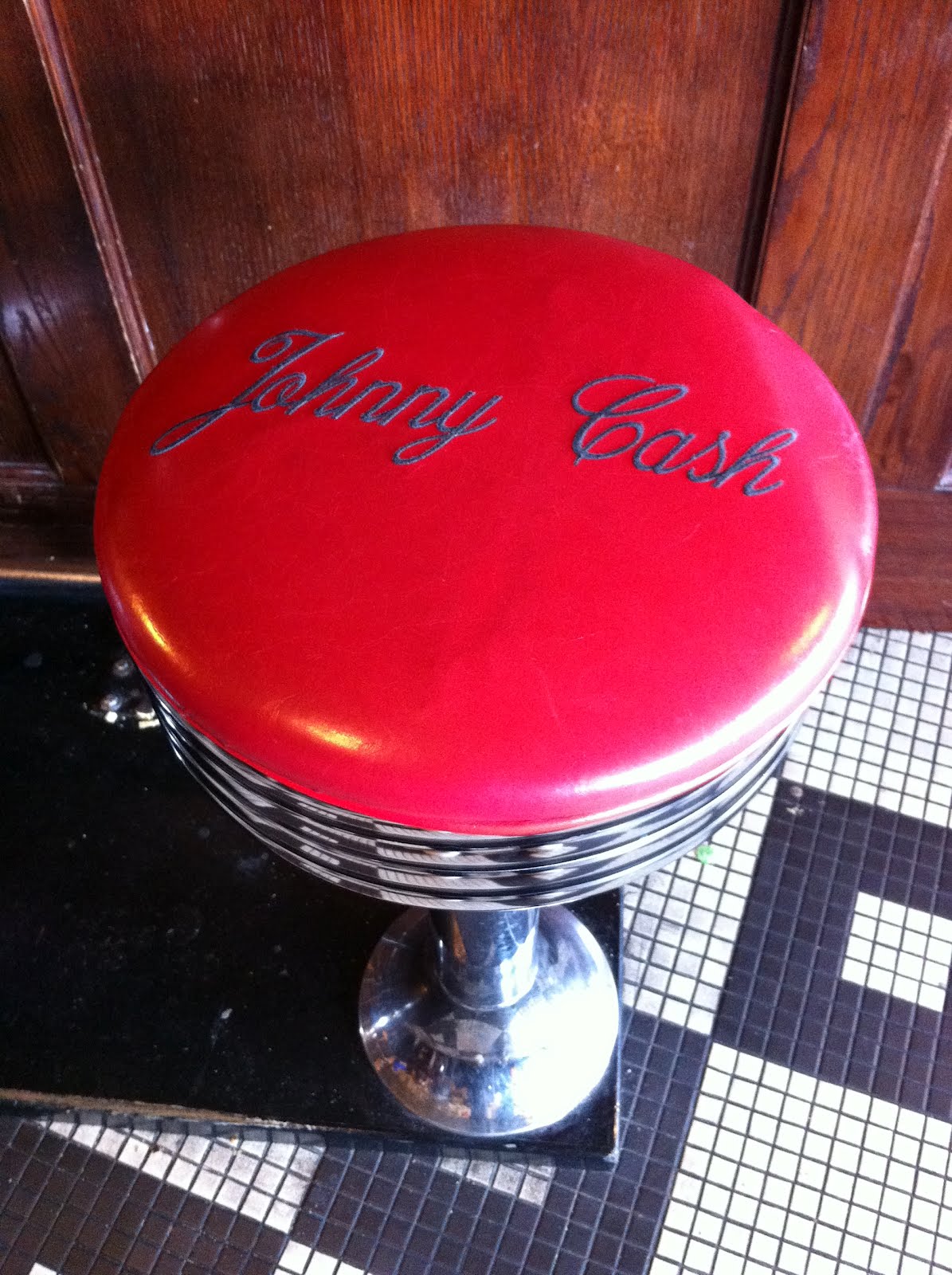
Walking through the door we were immediately into a room that operates as the reception, a souvenir shop and a cosy diner; mainly a diner/café. There were a couple of booths by the window and five red leather stools at the bar emblazed with the names Johnny Cash, Jerry Lee Lewis, Carl Perkins, Roy Orbison and Elvis Presley across them. I nabbed Johnny’s. Despite the stocks of t-shirts and stacks of gift items it didn’t feel especially touristy; just a cool place to order a bottle of coke and sit listening to the boom-chicka-booming in the background. The big geezer with the big quiff behind the counter was nuts for the Sun sound, it was obvious enough without the need for him to pull up his yellow Sun t-shirt to reveal a huge yellow Sun tattoo across his ample chest. All the people that worked there were undoubtedly Sun freaks first, employees second.

Jason was our tour guide and owner of a fine head of hair and bushy beard. Lord knows how many times he’d conducted this tour but he still sounded so passionate and excited his enthusiasm rubbed off instantly. He led us (a dozen yanks and us two limeys) upstairs to the tiny museum stuffed with old Ampex recording equipment, posters, records, stage outfits, all the usual stuff.

Sam Phillips set up shop here in 1950 as the Memphis Recording Service - he hadn’t yet started Sun as a label - so when Ike Turner and his Kings of Rhythm drove through the rain in March 1951 to record “Rocket 88” (credited to Jackie Brenston and His Delta Cats, a decision that must’ve irked Ike for the rest of his life) it was released on Chess, giving Chess in the North and Sun in the South join claims on what is broadly accepted as “the first rock and roll record”. Jason liked talking about firsts, or to be more accurate, “very” firsts, which is before your bog-standard first. He told us about “Rocket 88” and after giving it a big build-up as “the very first rock and roll record, made in this very building” hit a remote control in his hand and bang, Ike’s tinkling the ivories and Jackie’s honking his sax and bellowing about his jalopy. It was a simple idea yet bought the music and the place together perfectly in a way other studios (and I’m especially looking at you Motown with your singing flunkies) failed to do.

Howlin’ Wolf also recorded here during ’51 and as the unsuspecting punters stood before a cardboard Wolfman they got a blast of “Moanin’ At Midnight”. The look on their faces, eyes widening, as the Wolf’s guttural moans came booming out of nowhere was a sight to behold. Most of these people had never heard such a noise. The kid in front of me looked terrified. Hot on Wolf’s heels was the mighty “Bear Cat” by Rufus Thomas. The gathering had little difficulty in recognising the blatant rip from “Hound Dog” (so blatant the resulting lawsuit almost bankrupt Sun with its first hit), which finally led us to Elvis Aaron Presley.

Public Enemy spat out “Elvis was a hero to most but he never meant shit to me” on “Fight The Power” which is broadly how I feel (although Chuck D followed that with “straight up racist” which I don’t believe) but its churlish to come to Memphis and be snooty about Elvis. Jason told us about the very first time Elvis came to Sun; he played us his very first recording; we hear him played on the radio for the very first time; and we see his very first television appearance. He was all right though that Elvis. Nice voice, good looking lad.

We then shuffled downstairs into the studio. It felt like a studio because it still is. Vintage equipment was pushed to the sides of the small white pegboard walled room and folk were in the control booth looking like they were working. Amazingly when the premises had other uses (including life as a fishing tackle shop) before reopening as Sun in 1987, it stayed relatively untouched (even down to the light fittings), and if you believe Jason the marks and dents and grooves in the original linoleum floor show where the musicians stood and played. He hit his remote again and led us through a succession of classic cuts. They sounded bloody good too, although Mrs Monk and I disagree on whether Roy Orbison’s “Ooby Dooby” is a good record or not. I say yes but know she’s probably right.

The money shot when it came to the photo opportunity was the chance to pose with a vocal microphone used on recordings here in the 50s, in the shadow of an Elvis picture using a similar one. Jason urged people to have a go and recreate the curled lip. Despite feeling a wally I did quickly attempt to channel Johnny Cash recording “Get Rhythm” and due to the mic being used Johnny Rotten in the “God Save The Queen” video. I got it spot on too. Unfortunately Mrs Monk’s trigger finger was far too slow and snapped me looking like an embarrassed girl instead.

If anyone goes to Memphis they have to brace themselves to be asked on their return, “Did you go to Graceland?” We caught the shuttle bus from Sun and had a nose around “The King’s” gaff. I’d love to live there in its mid-70s time capsule: to chill in his TV/record room; to shoot pool in the pool room; to get smashed with my mates in the jungle room; and to have my cook knock up a few burgers in the tiny kitchen. None of the rooms were big and the main building was a lot smaller than expected. I bet Chuck D lives in a bigger house.



Click on the Monkey USA label below for further adventures: Motown, Stax, Chess and Buddy Guy.

Sunday, 20 November 2011

MONKEY USA PART 4: STAX, MEMPHIS, TENNESSEE


“Can you take me to Stax please?” Best sentence I’ve ever said to a cab driver. “Sorry sir, I’m not a taxi.” He was driving a something called a medical transportation vehicle. So, if you were in a Memphis hospital last month waiting for a new kidney, I apologise for the delay.

It did mean I got to say it again before we travelled the couple of miles from the tourist drinking dens of Beale Street to across the tracks to the noticeably non-tourist area of East McLemore Avenue. Funky part of town is the white boy euphemism for a poor black neighbourhood where it wouldn’t be advised to wander around alone. I hate saying things like this as it casts aspersions on the folk there, who – like anywhere – will consist of the friendly and not-so-friendly. The vast majority of Memphis people we met couldn’t have been nicer. However, had Mrs Monkey and I walked this particularly residential route we wouldn’t have looked more out of place had we been wearing Beefeater uniforms and whistling God Save The Queen. And quite frankly, if I were looking for an easy target, I’d pick on us. For a start, nobody in Memphis walks anywhere. It is eerie to walk streets so deserted. On the occasions you do see somebody they are immediately conspicuous. Later we’d walk a few blocks from Beale Street to the Lorraine Motel, the scene of Dr Martin Luther King’s assassination and now home to the National Civil Rights Museum (an extremely uncomfortable and moving experience) and the only person we saw was a toothless dude on a bike harassing us for money. I never fathomed how people got around as there were never many cars either. Maybe the locals have exclusive use of a series of underground tunnels. When the cabby dropped us off at Stax he said not to wander from the front of the building. He needn’t have wasted his breath, we weren’t going anywhere.

Back in 1959 Jim Stewart and Estelle Axton transformed a tired theatre on the corner of E. McLemore Avenue and College Street into the Satellite record shop, recording studio and label that would become Stax. The rest, you know. After Stax went bankrupt in 1975 the building went to ruin. Published in 1997 Rob Bowman’s Soulville USA, the definitive account of the label, ends on a sour note. The final page reading, “Tragically, in 1988 the Stax building was torn down. What should have been a national historic site remains in the late 1990s an empty field containing rubbish and junkie needles. It’s a disgrace, and speaks volumes regarding Memphis’s treatment of its African-American heritage.”

A disgrace indeed but Bowman can now have no complaints after a multi-million dollar investment as produced a tremendous turnaround. Stax – the name and the building - has been rebuilt on the same spot; the façade to the design of the original building, and houses the Museum of American Soul Music. Next door stands the Stax Music Academy, a non-profit organisation which uses “music education as a tool to enrich the lives of potentially at-risk children”. There's soul power, right there.

It’s difficult to fault the museum. Unlike other museum tours on our trip, this one was self-guided. It was huge; packed with over 2000 exhibits within a modern, well designed space. It starts with a short film about Stax beginnings, heyday and resurrection. Although not made too long ago it was noticeable how many artists have since passed away. The scale of the exhibition can be demonstrated by the first area which centres on an old wooden chapel that stood in the Mississippi Delta for over a hundred years. They didn’t just recreate Hoopers A.M.E. Chapel; they picked it up and dropped it here. With a gospel soundtrack playing and video archives around the outer walls, it firmly establishes the roots of soul in the church.

From there in, it’s a chronological story. It makes reference to non-Stax artists from James Brown and Aretha Franklin to the Motown stable and Memphis neighbours at Hi, but its focus is on its own acts, with the higher profile ones each afforded their own display of records, photos, instruments and personal items: Rufus Thomas’s funky boots, Mavis Staples’s dress, Otis Redding’s suede jacket, a suit belonging to Sam or Dave, but the most jaw dropping belongs to Isaac Hayes. Much is made of Stax being the perfect embodiment of racial harmony but after the death of Otis Redding, the assignation of King, and driven on by the new leadership of Al Bell, they became a potent symbol of Black Power. Nothing demonstrated power more than wealth and success and Hayes’s peacock blue 1972 Cadillac El Dorado pimp machine, trimmed with real gold and lined with white fur, with a television in the front and a bar in back, portrayed that in a most ostentatious manner. I’m not one for cars, but this was a sho’ nuff afro turner.

In keeping with the attention to detail spent on the exterior, Studio A has been rebuilt to the exact specifications of the original using previous blueprints, photos and surviving memories. I’d estimate the combined studios of Motown, Chess and Sun would fit within these four walls on this carpeted floor. Again true to the original it had been built on a slope (remember this started life as a theatre) with the raised control room where the stage had been. Set up ready to record another smash was the house band's equipment featuring Al Jackson’s drum kit, Steve Cropper’s guitar and amp, Duck Dunn’s bass combo, Wayne Jackson's trumpet, and the Hammond organ Booker T. used on – amongst other things - “Green Onions”.

There was also the “Hall of Records” which displayed hundreds of album sleeves (loads I’d never seen before) and walls filled with, possibly complete sets, of the blue “falling records” single releases and the yellow “fingersnap” ones. When all said and done, it’s the music that matters. It’s great to see where it was created, to see the stage outfits, to read the stories, to pay tribute, but you can’t put the sound, the feeling, the spirit, the emotion, the soul that comes out of those 7 inch pieces of vinyl into a museum. The subject matter alone makes the Stax Museum of American Soul Music the best museum I’ve been to; it’s as good as it gets, but nothing beats the music itself.

Next stop: Sun Records.


Sunday, 6 November 2011

MONKEY USA PART 3: MOTOWN RECORDS, DETROIT, MICHIGAN


Of all the places in the world I wanted to go, one stood out head and shoulders above the rest. Detroit. If you believe what some people say, Detroit is best avoided. It certainly has earned a reputation and it’s not now for its motor industry or Berry Gordy’s assembly line of hit records. But a pilgrimage to one clapperboard house that stands at 2468 Grand West Boulevard has been top of my wants list for as long as I can remember.

The train journey from Chicago to Detroit took longer than the scheduled five and a half hours as it crawled through the likes of New Buffalo and the wonderfully named Kalamazoo, which sits bang in the middle of the two cities. Most places looked small, suburban, with lots of little detached houses proudly waving Old Glory from a flag pole on the front lawn. That’s until you reach the outskirts of Detroit. The difference is as immediate as it is shocking. Fortunately I’ve never been in the remains of a war zone but that’s how these deserted streets with empty, vandalised, burnt out buildings appeared.

People are leaving the city in their droves. Twenty-five percent of the population have left over the last decade and almost a million since Gordy began his Motown Empire in 1959. According to The Economist, “Those who are left are likely to be the poorest, least-skilled and so least mobile. Only 11% of Detroiters aged between 25 and 34 has a college degree; in Seattle, the equivalent figure is 63%. Around 50% of the city’s adult black males are unemployed, and 38% of all Detroiters live below the poverty line.” The problems that create are obvious. Our waitress later in the day would, with a detectable hint of pride, claim Detroit was the second most dangerous city in America and not to go anywhere on foot.

If I was prepared for that bleak scenario I wasn’t prepared for Detroit train station. I was thinking it’d be a busy station yet it’s a tiny two platform affair. It could’ve been any stop tucked away at either end of the Central Line. I also thought there would be plenty of taxis not only one, hell bent on scooping up as many passengers as he could. Could he take me and Mrs Monkey to Motown? “Moo-tun?” he says. No, Mo-town. “Mar-tan?” No, Motown Records. The Motown Museum. Hitsville USA. Dancing In The Street. “You have address?” Incredibly, a cabby in Detroit had never heard of it. Even when supplied with the address he looked totally bemused but that didn’t stop him scooping up an Austrian couple and squashing them in with us. They wanted a completely different destination and direction and despite Mr. Cabby’s promise to drive there afterwards they looked terrified by the prospect. It wasn’t like they had much choice.

A few minutes later – out of the blue - we were there. Motown’s headquarters and home to Studio A, the building Gordy named Hitsville USA. It looked wonderfully familiar, the same as in every picture, frozen in time: white structure, blue signage, and small strips of green lawn out front where the Miracles, the Temptations, the Supremes, Marvin Gaye, the Vandellas, the Marvelettes and all the other magnificent lesser known artists would take a breather from recording the Sound of Young America and hang out amongst friends. The building is pretty and picturesque but because of how it looks in photographs I’ve always imagined it on a quiet residential street, maybe it once was, but it’s in fact on a busy unattractive main road and now untypical of its neighbours.

In through the door marked Studio A, past the small gift shop on the left, and down a short narrow corridor leading to the tour kiosk. We missed the start and after getting the lift up one floor the door opened into the main museum area where a dozen people were listening to an excited guide. I’ll call him Eivets Rednow. He explained how Berry Gordy needed a family loan of $800 to start his label and how Marv Johnson’s “Come To Me” was the first release on Tamla, the first of his many labels under the Motown umbrella. We heard how Gordy swiftly worked his way onto his first national hit, courtesy of Barrett Strong. Eivets Rednow breaks into song. “The best things in life are free, you can give them to the birds and bees…” He starts clapping his hands, and saying he can’t hear us. “I want money, that’s, what I want.” This set the tone for the tour: all singing and clapping and audience participation. I could feel myself and Mrs Monkey mentally moonwalking back to the lift.

We worked our way, as a group, around the room filled with records, photographs, tour posters and other promotional material displayed in glass cases whilst Eivets gave a thumbnail account of the Motown Story. With such a wealth of talent, for all the hits and misses, it was interesting to see which artists were afforded more space in the exhibits and the tour narration. The Supremes, for all their stature, scored lower than I predicted; the Four Tops were lucky to have their photo in a shared collage; whilst Marvin Gaye would’ve felt vindicated to get top billing with three complete cabinets to himself and Eivets bursting into Pop Idol versions of “Ain’t No Mountain High Enough”, “I Heard It Through The Grapevine” and “Sexual Healing”.

When Berry Gordy bought the premises he had a clear idea how he envisaged his operation to work: he would live upstairs, have his offices downstairs, and would convert the garage into a recording studio. All of which we see. His living area was kitted out with a mix of his own items and period pieces but it’s when the tour moves downstairs that we are spookily transported back to the early 60s. The reception area and desk where Martha Reeves worked as a secretary is there; a leather sofa where artists would wait is positioned just inside the front door reserved for the elite few; Gordy’s office has a memo pinned to the noticeboard from 1965 warning employees that card games are forbidden until after 6pm; a room filled with master tapes overlooks a candy machine stocked with Stevie Wonder’s favourite bar - fifth button from the right - so he always knew where it was; and there’s the control room complete with the original three-track mixing desk. Visitors were forbidden from taking photographs so I can't show you the evidence.

Standing in the doorway of Studio A – the Snakepit as the Funk Brothers named it – and walking down the few steps into it was a once in a lifetime hairs-on-the-back-the-neck moment. Even Eivets shut up as we silently sucked in the moment. It felt like entering a church. It smelt old and musty and damp. It felt cramped squeezed in amongst the instruments and equipment but here it was. Here was the Motown Sound. Here was “This Old Heart of Mine”. Here was open for 24 hours a day between 1959-1972, recording the greatest collection of music ever to come from one studio. Earlier we’d seen the echo chamber where handclaps and backing vocals were recorded (echo chamber is a grand description of a hole and microphone in the ceiling to create a reverb effect) and presently we’d see the room where the horns where recorded, but this was it. Soul Mecca. There were no flat concrete walls; it was all warm timber angles, soaked with sweat and soul. Amazing.

Now, what would have taken this to another level would’ve been to have some big Motown hits pumped through the studio PA. To hear the snap of Benny Benjamin's snare, the rumble of James Jamerson's bass, to hear Levi soar, or Smokey sing. But no. Eivets lined up the girls and made them curtsey and throw some Supremes shapes. I couldn’t look at Mrs Monkey as felt her obvious discomfort and waited instead for the tables to turn. Us boys had to sing “My Girl” and do The Temptation Walk. In the privacy of my flat I happily dance around like David Ruffin – I could’ve been Motown’s great white hope - but this was embarrassing as I performed a half arsed left to right to left shuffle and mumbled something about the month of May. A couple of my fellow Tempts didn’t share my English reserve.

We can now claim to have sung and danced in Studio A. Berry Gordy might not have signed us but what he gave was more than enough. A dream come true.

Next stop: Stax.

Thursday, 27 October 2011

MONKEY USA PART 2: CHESS RECORDS, CHICAGO, ILLINIOS


In his autobiography, Keith Richards calls 2120 South Michigan Avenue hallowed ground. He and other Stones love telling how when they arrived in June ’64 to record in the footsteps of their idols, Buddy Guy was there to greet them, Willie Dixon too, Muddy Waters – they claim – was painting the ceiling and helped lug their gear out of the van and up the stairs into the studio. Etta James was no doubt fixing them up something in the kitchen.

Since 1990 the site of Chess Records has been designated an official Chicago landmark, and since 1993 home to the Willie Dixon Blues Heaven Foundation. When we turn up around midday we weren’t afforded such a welcome. The glass front revelled little of what’s inside and the place looked empty, so we rang the bell. After a while a man languidly comes to the door. I worry we’ve got him out of bed. His name turns out to be Kevin although we didn’t know that at the time. Didn’t know who or what he was. He picks the post off the floor and asks “you here for the tour?” Yeah, is that alright?

He leads us into a room with a desk and some mugs and t-shirts on display. It would stretch things to call it a gift shop. “You musicians?” he asks. Now, whenever I’m asked this, I always take it as a compliment but it’s not really is it? In my head all musicians look like The Action in ’66, The Stones in Green Park, the house bands of Motown and Stax, the dudes on Blue Note sleeves, where in reality, most are lucky to play a regular pub gig and inevitably wear a faded tour t-shirt and jeans that don't fit properly. “No, but I DJ in London and play old rhythm and blues records including, of course, loads of Chess stuff”. This was the second night in a row I’d thrown in the DJ line and felt myself squirm with uneasy self-consciousness saying it, but in my defence it was to (a) demonstrate we knew why we were here and (b) hope to engage Kevin in some conversation. It didn’t work. He said something about costing us $10 each and watching a video. We paid up.

He led us upstairs to a room filled with stackable plastic chairs and sat us in front of a big television and put a well-worn VHS cassette into the video player. “You watch this and when it’s finished I’ll come back and answer any questions.” With that he was gone. Looking around it was apparent we were in what was once the main recording studio of Chess. There wasn’t much beyond the white pegboard walls to give this impression but the big control room window in front of us gave it away. The video whirred into action and started to play a documentary called Sweet Home Chicago. It told of the blues, Chicago and Chess. It was probably made in the early 90s and was all right. It set the scene. But it went on. And on. We had no idea when it would end. Maybe it was a full 90 minute feature film? It was like watching BBC4 on a Friday night minus the bottle of wine and packet of Twiglets. There we were, sat alone, in the room where hundreds of amazing R&B and soul numbers were wrung from the sweat of incredible musicians; watching the telly.

After about an hour it finished and Kevin popped back. “Any questions?” Er, about the film or Chess in general? “Whatever you want.” I take it this was the studio? It was, and the control room was indeed the other side of the glass, and at the back the two rooms were the audition and rehearsal rooms. How long did Chess use it? Kevin said right up until 1969 when Leonard Chess died. The plaque outside said 1967 when I’ve read they moved to larger premises. Can we have a look around? “Sure, I’ll go back downstairs, come down when you’re ready. Take as many pictures as you want”.

It was difficult to get much sense of what recording in that room was like. It was now simply a rectangular room, high ceiling, with flat walls, and an old piano in the corner. There’s a distinctive echo to Chess records; an open, sparse feel. I tried to hear Little Walter’s harmonica in the walls, feel the stomp of Chuck Berry’s duck walk across the floor. It was difficult. The two back rooms contained some items of memorabilia but nothing much to write about: Dixon’s jacket and hat, KoKo Taylor’s dress, a few guitars, records and various odds and sods. The control room contained a couple of ancient pieces of recording equipment. One, bizarrely, was perched in a metal serving tray on top a wooden cross frame. I’ve no idea whether these were from the original control room or put there for illustrative purposes.

Back downstairs Kevin was sat behind his desk. When asked what the Willie Dixon Blues Heaven Foundation is, he came to life and passionately explained how it was set up at Dixon’s request, to educate blues musicians about the music business, to help those who needed assistance in understanding contracts and the legal implications of what they had signed, to help find work and act as intermediaries when third-parties were looking for performers, to help those in trouble etc. “Musicians are artistic people. They need to be free to create. They can’t do that when dealing with contracts they know nothing about”. It was good to hear. He also admitted that they more or less keep the upstairs open for fans to come along, just so they can say they’ve been before getting on a roll about the standard of blues clubs in the city. We mention we went to Buddy Guy’s club and met him. “What was he like?” I think he’d had a few drinks. Was quite sweary. “That’s Buddy. But what were the chances of that? Back in the day, you could see Howlin’ Wolf, Muddy Waters, Willie Dixon; they all lived here and played here. In those days you had to reach a certain level before they’d even let you in those clubs. Now they put on anything just for the tourists”.

As we leave the buzzer goes. Kevin lets in a couple of fellas. “You musicians?”

Next stop: Motown.

Sunday, 23 October 2011

MONKEY USA PART 1: BUDDY GUY'S LEGENDS CLUB, CHICAGO, ILLINIOS


Chicago likes to call itself the Home of the Blues, even if there aren’t too many bluesmen left at home. Buddy Guy moved to the Windy City in 1957, started cutting records as a session man for Chess in 1959, and is still doggedly keeping the blues alive with his own club, Buddy Guy’s Legends, situated at 700 South Wabash in the studenty part of the South Loop area.

The first things you notice as you approach the club are the large blue and white checker mosaics on the outside wall depicting the likes of John Lee Hooker and Howlin’ Wolf. Inside, it’s much how you’d expect, with photos, memorabilia and signed guitars hung on plain brickwork. It’s not dissimilar to a better equipped 100 Club with its wide but narrow layout and a bar at both ends and a low stage in the middle.

Me and Mrs Monkey popped in for a look on a lunch time and ended up eating catfish tenders, bourbon shrimp and having friendly locals offering us drinks. None of which is ever likely to happen on London’s Oxford Street. There were a couple of blokes on stage performing for the handful in there and luckily for them I didn’t catch their names. They did an atrocious version of “Goodnight Irene” - not that there has ever been a good version of that hideous song – and some other faux blues like every tin pot bus station busker from here to Timbuktu thinks is acceptable to pass off to the ill-informed or cloth-eared. It did though make us think that it would be a good venue to see someone half-decent.

So we went back that evening and Jimmy Johnson, a long standing Chicago blues guitarist and brother of Syl Johnson (got a couple of his singles tucked away somewhere), was on stage playing Junior Wells’ “Little By Little”. He had a cool laid back soul-blues style about him. Neat playing: nothing too showy, no face twisting histrionics. We stood at the bar with a beer and dug him. “Don’t turn around but I think that’s Buddy Guy behind us,” says Mrs Monk. I naturally turn around immediately and there’s a dude in the corner wearing a hat, blue smock, slouched on his stool, nursing a drink and chatting to a lady friend. We couldn’t get a proper look of his face but if he wasn’t Buddy he had the unmistakable look of being somebody. Not that we waited long for confirmation, it was him all right, as he soon climbed stage to hold court. You know in Raging Bull when Jake La Motta’s boxing career is over and he opens his own nightclub and drunkenly chats to the audience? It was a bit like that. I’ve no idea what got him on to the subject but he told how when he and Junior Wells arrived in Chicago (“you remember this too Jimmy”) the entire Chess crowd called them motherfuckers. “We thought it was our name,” he says, effortlessly breaking the Richard Pryor record for most motherfuckers and shits in a ten minute spell, only interrupted by singing his way through a couple of blues vamps. He also railed against the lack of blues played on the radio and how he keeps the club open as that’s the only way folk get to hear the blues in the city. Unfortunately he didn’t pull a guitar from the wall before the band went into the interval and he went into a photo and signing session by the club entrance.

It wasn’t possible to engage him in much chat but he was gracious in having his picture taken (one had to give their camera to his burly security guy to do the honours) and I did manage to tell him how I and others play his “I Dig Your Wig” single in clubs around Europe. It’s a popular tune. He pauses for a moment as if wondering what the earth I’m on about before a flicker of recognition hits his face. “Man, that’s from waaay back”. We shake hands. It’s a great moment. For me anyway.

Back in the main part of the club Jimmy Johnson was sat by himself with a coffee. He’d almost been upstaged at his own gig so we took the table next to him and asked him how he was doing. He said he was bit bored, which wasn’t the kind of answer we were expecting, but would be okay once he got back on stage. Jimmy turned out to be a lovely bloke and seemingly happy to chat to us. He said he’d been a professional musician since 1959. “What’s that been like? Bet there’s been some ups and downs?” I said, unaware that in 1988 his band’s van came off the road killing his bassist and keyboard player. It was hardly the right time for him to mention that horrible incident, and he struck a very positive note instead. “I been all around the world and I ain’t never bought no plane ticket.” I asked him about Buddy’s cussing; did everyone really call each other motherfucker? “Sure, that’s just how we spoke. We all call each other nigger too, like ‘hey nigger, how ya doing?’ Just how it was, don’t mean nothin’. Except say if you say it, there might be some meaning behind it. You know what I’m sayin’?” I knew what he was saying.

Jimmy asked where we were from and so told him London and that we got married on Saturday. When a man of 82, married for nearly fifty years, offers you advice, you listen. To me he says “you gotta learn to say ‘yes dear’” and to Mrs Monk he says “you’ve got to remember it’s we not me”. He also offered us advice about looking after ourselves when we travel to Detroit, and when back on stage he dedicated a couple of Motown songs to us, thoughtfully doing “I Wish It Would Rain” and “Get Ready”.

It’s hard to imagine how a night out looking for the blues in Chicago in 2011 could’ve been any better. Next stop: Chess Records.