Showing posts with label charles bukowski. Show all posts

Thursday, 28 March 2013

THE NEW WORD ON THE STREET: PUSH – ISSUE ONE


New literary fanzine PUSH might better be called KICK or WHACK such is the impact of its writing. Across 42 simply presented pages it features previously unknown writers like Jeff North, Carlton Burns, Ian Scanlon and some character Dirty Boozy Bastard, alongside names familiar to followers of the underground lit scene: Joseph Ridgwell, Michael Kennaghan, That Petrol Emotion’s Raymond Gorman and editor Joe England.

Sold at a giveaway price of £1.50 on the streets, outside football grounds and at gigs, the uncompromising prose isn’t for the faint hearted. Amalgamating pop culture, drug paranoia, rushed sex, football hooligans, and the threat of violence, it is just one glance away from a character in a John King novel. In the way football matches offer a valve to release pressure and tension, these writers hammer their words. By way of balance, the poems offer quieter contemplation and snatches of respite from the onslaught of tough fiction. I asked Joe England about his inspiration for launching a new mag.  

“I suppose PUSH had its origins for me when I recently discovered the wonderful world of the small press, firstly through Blackheath Books which I found out about through back-reading Monkey Picks, and then other doors opened up courtesy of Joseph Ridgwell. I love the whole approach of the small press, the limited print runs and the amazing quality in look and writing. I have a great appreciation of online litzine’s like Melissa Mann’s Beat The Dust, but online/e-reading just isn’t the same as holding a publication in your hands. Same reason why the experience of vinyl still cannot be beaten. What kicked this in motion was four weeks ago when I managed to get my hands on an issue of Kevin Williamson’s Rebel Inc. mag from 1993 and in an email conversation I mentioned to Joseph Ridgwell how the world needs a street lit fanzine right now as much as it did back then. ‘Do one then’, he said and within three weeks I was selling PUSH on the street and posting it to various parts of England, Ireland, Scotland, Sweden and Germany. At a football match the other week, witnessing a complete stranger engrossed in issue one was mind-blowing. If the same chap was reading a PDF file of PUSH on a Kindle the impact would have been soul-burning.”

Such is England’s rush of enthusiasm that issue two is already nearing completion. These things tend to succeed or fail on the strength of their editor. Despite making his name and being championed by the small press, Charles Bukowski constantly bitched against them in his letters, claiming they only lasted a couple of decent issues until editors lost their bite and accepted poor quality submissions from their mates or famous poets (even himself). If PUSH can keep the standard of its first issue (Keenaghan’s “Bent” is worth the cover price alone) there’ll be no complaints here and besides, it’s a heck of a lot better than reading the excuses from Sam Allardyce or Harry Redknapp in the match day programme.

Contact pushmag@email.com for ordering details or visit Joe England Books.
West Ham United legend Julian Dicks models PUSH.

Wednesday, 16 May 2012

JACK KEROUAC IN BEAT SCENE ISSUE 67


Jack Kerouac would have been 90 this year and is celebrated in the latest issue of Beat Scene with a host articles, mostly exclusive to the magazine. 

Editor Kevin Ring unravels the tangled history of Visions of Cody, as well as recounting a disastrous television appearance; Jim Burns separates the fact from fiction in Maggie Cassady; Olle Thornvall runs with the influence of Jack’s hometown of Lowell and how it shaped Doctor Sax; and there’s a small piece on the until recently lost first novel The Sea is My Brother.   

Kerouac apart, there’s a good look Charles Bukowski’s doddles (or “atomic scribblings” as Abel Debritto calls them) and the usual peak into the more obscure corners of the Beat universe plus the always excellent reviews section. 

64 pages on decent quality paper without a single advertisement and yours for the price of a pint.  For ordering details and more information visit Beat Scene   

Wednesday, 25 January 2012

POETRY PICKS #2: THE BLUEBIRD by CHARLES BUKOWSKI

If you only think of Buk as a boozing, gambling, potty mouthed womaniser, this might come as a surprise. I include it below not just on its merit but to show this beautiful 2009 animation by Monika Umba from the Cambridge School of Art.

there's a bluebird in my heart that
wants to get out
but I'm too tough for him,
I say, stay in there, I'm not going
to let anybody see
you.

there's a bluebird in my heart that
wants to get out
but I pour whiskey on him and inhale
cigarette smoke
and the whores and the bartenders
and the grocery clerks
never know that
he's
in there.


there's a bluebird in my heart that
wants to get out
but I'm too tough for him,
I say,
stay down, do you want to mess
me up?
you want to screw up the
works?
you want to blow my book sales in
Europe?

there's a bluebird in my heart that
wants to get out
but I'm too clever, I only let him out
at night sometimes
when everybody's asleep.
I say, I know that you're there,
so don't be
sad.

then I put him back,
but he's singing a little
in there, I haven't quite let him
die
and we sleep together like
that
with our
secret pact
and it's nice enough to
make a man
weep, but I don't
weep, do
you?

The Bluebird by Charles Bukowski is published in The Last Night of the Earth Poems and The Pleasure of The Damned.

Saturday, 3 September 2011

BEAT SCENE - ISSUE 65, SUMMER 2011


Every quarter Beat Scene magazine turns up at my door, more like a groovy uncle than a foxy new girlfriend, but it’s fiercely loyal, dependable, and I always put the kettle on to enjoy a few hours in its company.

It brings me news and tells tales of days of yore. For example, it reports there will presently be two film adaptations of, in my opinion, Jack Kerouac’s best two books: On The Road and Big Sur. I’m fairly ambivalent about these types of projects. Whether good or bad, they’ll come out and disappear, most won’t even notice, but a handful of observers will go back to Jack himself and possibly the Beats in general. They need all the help they can get these days. When Jack needed help he didn’t get much. As far back as 1959, Beat Scene editor Kevin Ring observes in his thorough account of Jack’s relationship with his agent Stirling Lord, “Jack was disappointed that film adaptations of his books seemed slow in materialising”. Jack, at the time his star shone brightest, already needed the money; ten years later in near poverty and tatters, he drunk himself to death. Ring’s account is close to a classic be-careful-what-you-wish-for story.

Happier news comes in the shape of an excerpt from a forthcoming Charles Bukowksi collection; lots of book reviews; articles about Ed Sanders, Gary Snyder, Janine Pommy Vega and more; and, especially for David Beckham, a 1987 interview with Allen Ginsberg.

A bumper 68 A4 page edition for a four pounds sterling. I’ll drink to that. Find ordering details at beatscene.net

Thursday, 7 October 2010

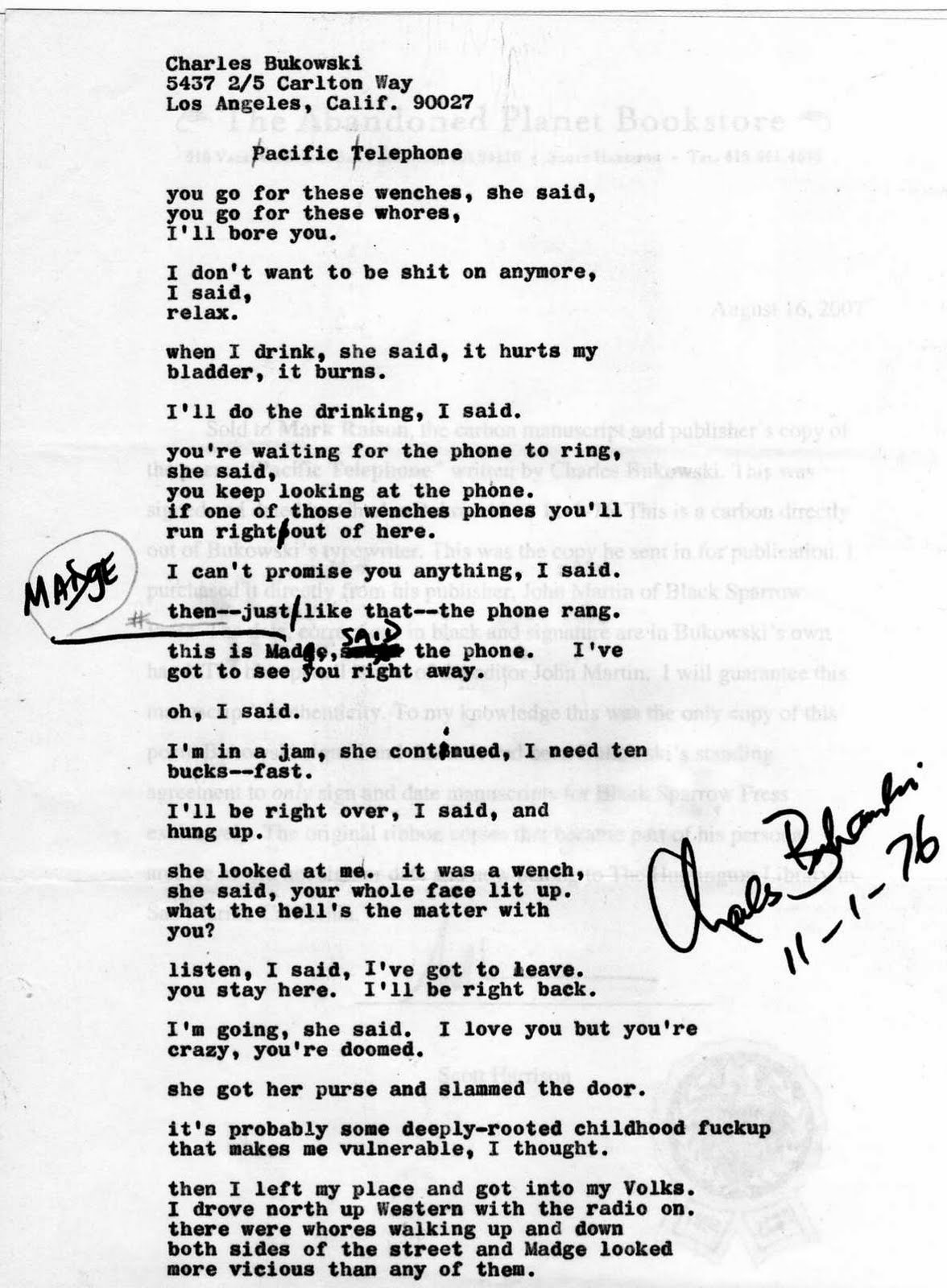
NATIONAL POETRY DAY: "PACIFIC TELEPHONE" by CHARLES BUKOWSKI


Today, apparently, is National Poetry Day. I’ve no idea what it involves nor do I care, but it's a good excuse to share one of my most treasured possessions with you that hangs proudly from the marbled walls of Monkey Mansions.

Above (click on it) is the original manuscript straight out of Charles Bukowski’s typewriter of “Pacific Telephone”. As you can see he wrote it on 1st November 1976, signed it, and posted it to his publisher John Martin at Black Sparrow Press. It appeared in Love Is A Dog From Hell the following year. The black pen marks are by Bukowski and the pencil marks by Martin.

It is so typically Bukowski and you can hear him so clearly reading in that slow lazy drawl and then adopting the whiney voice he used whenever speaking on behalf of the women in his life.

Bet old Hank would’ve loved National Poetry Day…

Sunday, 18 July 2010

ABSENCE OF THE HERO by CHARLES BUKOWSKI


Absence of the Hero follows 2008’s Portions from a Wine Stained Notebook in gathering previously uncollected short stories and essays from Charles Bukowski written between 1946 and 1992. That might sound like a ragbag collection of inferior works – rarity collections often equate to “for fans only” i.e. “a bit shit” – but that doesn’t apply here. Both volumes whether taken as introductions or additions to his famous stuff offer more evidence of his brilliance and (like The Pleasures of the Damned reviewed in February) show a versatility and breadth of writing his naysayers don’t give him credit for.

“The Reason Behind Reason” gets things moving in 1946 with “Chelaski” playing baseball. He smashes a long drive and stands on the plate as players and supporters go berserk at him for not running. Chaos ensues but he’s motionless in the eye of the storm. He looks around and walks off. That detachment from the crowd, that shell, that climbing into himself is carried into “Love, Love, Love” as his mother asks him “why do you keep your eyes on your plate? Why don’t you look at people? Look at me…” It’s not quite misanthropy, as he wrote somewhere I can't remember it wasn’t that he hated people - he just preferred it when they weren’t around. Grumpy git.

There are 39 entries, selected and introduced by David Stephen Calone, covering the autobiographically based stories, the funny flights of fancy (check the gruesome yet deadpan hitch hiking story “Christ With Barbeque Sauce”) and studious examples of literary criticism that belie his drunken bum persona. It’s not quite as good as Portions but only in the way a 4-0 win isn’t quite as good as a 5-0 win; it still wipes the floor with the opposition. Absence of the hero? Who’s he kidding?

Absence of the Hero: Uncollected Stories and Essays Vol. 2 1946-1992 by Charles Bukowski is published by City Lights Books, priced $16.95

Saturday, 10 July 2010

BEAT SCENE ISSUE 62


Charles Bukowski may be the cover star of the Beat Scene 62 but it’s the new nine page interview with Carolyn Cassady that steals the issue for me. She’s written and spoken many times about her husband Neal Cassady and lover Jack Kerouac but I’m never less than fascinated by their relationship. I still can’t grasp the hold Neal had over people – Carolyn in particular. Even his portrayal in On The Road isn’t flattering: a con-man and a rat who abandons a sick Jack in Mexico; and that’s without the bigamy and constant philandering she had to deal with. Maybe she was hip and I’m squarer than I’d care to admit.

Continuing the spouses theme, Richard Brautigan’s first wife Virginia Aste is also interviewed. There’s a good article about Kerouac and his time in Detroit with his first wife Edie Parker (who Carolyn memorably refers to as a weirdo and a nut case). Bukowski gets his coverage - reviews and extracts from a couple of newish books. Dan Fante writes about his father, John Fante, and fellow writers blacklisted by Hollywood during the 40s.

Loads of other stuff as usual within its 64 advert-free pages. Four pounds stirling.

www.beatscene.net

Sunday, 21 March 2010

BEAT SCENE ISSUE 61


It must be twenty years since I first bought Beat Scene issue 9 – with Charles Bukowski holding one of his cats on the cover – from Compendium Bookshop in Camden Town and have bought every one since. Now up to issue 61 and it keeps getting better. Where else would you find a twelve page piece about William Burroughs in Denmark?

Other articles include Burroughs and Drugs, Eddie Woods remembering Harold Norse and a tribute to Jim Carroll. Among the reviews are books by Dan Fante, Charles Bukowski, Knut Hamsun, and Michael McClure.

Loads of other stuff crammed in its 64 pages. Yours for a mere £4 at Beat Scene.

Tuesday, 9 February 2010

THE PLEASURES OF THE DAMNED: POEMS, 1951-1993 by CHARLES BUKOWSKI


In my head, all right minded folk know the work of Charles Bukowski, recognise a Smiths lyric, and can tell you the result of the latest QPR game. I’m kidding myself of course (although the last one is easy to guess) but The Pleasures of the Damned offers a quick leg-up for those slouching in the Bukowski stakes. I always think a bookcase without Bukowski is a bar with no beer, so now's a good time for some of you to stock up.

First published by Ecco in 2007 as a classy looking hardback, the 2010 Canongate paperback gets a scowling, fag butt smoking Bukowski on the cover with sloppy “punk” lettering. Yeah man, cos that’s what he was like yeah. Crazy punk, didn’t give a fuck. Well, as it happens, boys and girls, he cared a great deal how his books were published and presented and I don’t expect he’d have been too chuffed with this one. But yeah, maybe for a lot of crappy pointless other stuff, he didn't give a fuck.

John Martin, his editor and publisher, a man so convinced of Hank’s talent he promised him money for the rest of his life if he quit his job at the post office, has selected the 250 poems to create a “Best of” collection. With thousands to choose from everybody will have their own choices but I immediately thought of five - and four of those are here, so that’s a decent percentage. Plus I only had to wait until the sixth entry for my absolute favourite, The Last Days Of The Suicide Kid. I know reading 250 poems sounds like some sadistic punishment dished out at school for fighting in the corridor but bear with me.

Even those with a cursory knowledge of our man will think of him drinking, shagging, and betting on horses. All reasonable stuff but he goes deeper than that. Although frequent topics, his work was seldom about those things as Martin is obviously at pains to show: his selections spread across five decades have the effect of watering down Hank’s more contemptuous nature found in individual volumes of his work. He played the tough guy role well but he had heart, he had soul, he had a strong sense of morality and decency (admittedly harder to spot after too much sauce) and he could be a big softie (just count the number of poems about his cats). “I do have feelings, you know”, he confirms, aware it’s not always noticeable in The Angel Who Pushed His Wheelchair. Those feelings and compassion was especially acute for the outsider, the underdog, the lost, the lonely, the homeless, the drunk, the foolish and increasingly before his death in 1994, the sick and the elderly. To Hank, skid row bums would rise in the haze of a drunken hour “like millionaires” and have “the most beautiful faces in town”. This would be romantic balderdash in less knowing hands than Bukowski’s.

He could also be very funny, usually at his own expense, and sensitive, as the poems reflecting on the death of Jane Cooney Baker who he’d enjoyed/endured a fifteen year on-off relationship show.

The poems aren’t presented in chronological order but they hang nicely together in little thematic batches. They aren’t dated either so you have to guess when they were written by flicking to the back to see what book they came from, and then turn to the front to see what year that was published. It’s difficult to date a lot of them anyway as they would sometimes sit with John Martin for years before being issued; decades, in the case of some posthumously published ones. If I wasn’t such a precious fusspot I’d annotate the pages in pencil. With over 500 pages it’s better to forget it and concentrate on the words.

I’m guessing most would start with Bukowski’s novels and short stories but fear not the poetry. These are only like shorter stories anyway. Everything he wrote was in his deceptively simple style. He told it just like it was. If it was shit stained, he'd tell it. It looks so easy he spawned a million imitators but few can get the line down with such little fuss and get straight to the truth, however uncomfortable it might be. Back in the 1960s in Notes of A Dirty Old Man he wrote, “An artist is a man who says a difficult thing in a simple way”. There you go, I rest my case.

The Pleasures Of The Damned: Poems, 1951-1993 by Charles Bukowski is published by Canongate, priced £14.99.

Wednesday, 3 February 2010

JOHN FANTE - A CONVERSATION WITH BEN PLEASANTS


“Fante was my god”. As the rule states no mention of John Fante is allowed without Bukowski’s quote, I’ll get it out the way now.

Fante’s 1939 Ask The Dust was one of those books that as soon as I read it I couldn’t spread the word quick enough. Every person I told or I bought a copy for loved it immediately and hunted out his other books, particularly those starring his alter-ego Arturo Bandini.

He was blind and nearly seventy by the time Ben Pleasants interviewed him in the late 1970s. Those interviews have remained unpublished, except for a small segment released last week as a Beat Scene Press chapbook, John Fante - A Conversation with Ben Pleasants. Naturally enough he talks about Ask The Dust, as well as reminiscing about his pal Willam Faulkner and F. Scott Fitzgerald’s handshake. There are no earth shattering revelations but it’s a nice little collectable addition to the Fante shelf.

John Fante – A Conversation with Ben Pleasants is published in an edition of 125 numbered copies by Beat Scene Press, priced £5.95 at beatscene

Sunday, 8 November 2009

86'd by DAN FANTE


Like most of John Fante’s current readers I discovered him via Charles Bukowski. Buk claimed him as his God, and that’s enough endorsement for anyone. Books like Ask The Dust and The Road To Los Angeles made aspiring writer Arturo Bandini an unforgettable creation: a self-absorbed romantic dreamer thoroughly convinced of his own genius.

Back in 2002 I saw Fante’s son, Dan, give a talk. He spoke about his father, Bukowski, and his own writing. I wasn’t much interested in his own writing until he read the opening pages from Mooch and was converted on the spot. It felt like the passing of the baton. We shared a few words and he wrote in my copy of Mooch “For Mark, I hope you like my new book – It drove out many old demons for me. Best, Dan Fante”. Many old demons, I’m sure, but a stack of novels, plays, poems and short stories later, Fante is still wrestling those demons and fending them off the way he knows best - the only way - with the written word.

86’d follows familiar ground as Fante’s alter-ego Bruno Dante woozes through the streets of LA struggling to keep a limo driving job and the booze at bay. Not a great combination. No sooner he climbs aboard one side of the wagon, than he spectacularly stumbles off the other. But through all his failures, blackouts, mental girlfriends, AA meetings and dumb moves, you’ve got to admire his pig headedness and dogged spirit even through the skuzziest of lows. “My life wasn’t a total shit sandwich”, he says. And it is dead pan lines like that, that make reading Fante such a treat. Also, no one throws abuse with such casual ease. As the pages get darker, and the voices in his head get louder, his fuse gets shorter. From shooting vitriolic insults from the hip, to indignant rage, to psychotic fury, the angrier he becomes the more incisive and funnier the writing.

Much of the story and characters are predictable but that’s hardly the point. 86’d contains a couple of Fante’s most memorable passages, which I won’t spoil here, and overall this may well be his best novel.

86’d by Dan Fante is published by Harper Perennial, priced $13.99.

Thursday, 17 September 2009

LAST DAYS OF THE CROSS by JOSEPH RIDGWELL


When I first came across Joe Ridgwell’s writing a few years back – mainly short stories scattered across the internet - he claimed to be the author of a novel Last Days of the Cross. After searching for it to no avail I put it down to self-mythologising bullshit, but no, here it finally is courtesy of new independent publishers Grievous Jones Press.

Ridgwell delivers straight down the line, no nonsense, no fussing, unpretentious, conversational storytelling where the words fly off the page. In Last Days of the Cross his romantic notion of becoming a poet lands him in Australia, where he assumes wondrous poems will come tumbling forth to critical acclaim and Joseph Ridgwell Appreciation Societies will be founded. That he chose Australia in the first place shows his head ain’t screwed on straight and further evidence of his rash heart-ruling-the-head nature comes when Joe falls for a junkie prostitute who’s just nicked his money.

There are obvious (and acknowledged) influences of both Arturo Bandini’s delusional claims of artistic greatness in John Fante’s Ask The Dust and Henry Chinaski’s need to hustle ridiculous jobs as poetry doesn’t put beer in the fridge from Charles Bukowski’s Factotum. Readers of those will find much to enjoy here as the tale wobbles from self-inflicted heartache to pure comedy on the turn of a page, leading to a cringing will-he/won’t-he dilemma when faced with an unexpected proposition.

Thoroughly recommend this and as good as it is I predict Joe’s next one will be even better. That appreciation society might not be too far away.

Last Days of the Cross by Joseph Ridgwell is published by Grievous Jones Press, priced £10. www.grievousjonespress.com.
In Search of the Lost Elation at www.josephridgwell.blogspot.com

Thursday, 13 August 2009

BEAT SCENE ISSUE 59


It’s always a joyous moment each season when the latest Beat Scene hits the doormat. The summer edition is out now and stuffed with news and features on all your beat related characters and their literary and literal offspring.

Issue 59 includes big hitters Burroughs and Bukowski mixing it with less familiar names Kay Johnson and Allen Deloach; amongst the book reviews is Jan Kerouac: A Life In Memory which should make a fascinating read following the recent court case; an interview with my old goldfish’s namesake Herbert Huncke who talks candidly about drug addiction, prison and hooking up with the New York beat crowd; and much more.

I’ve one spare issue to give away to the first person who sticks their hand up. The rest head to www.beatscene.net