Showing posts with label beat scene. Show all posts

Tuesday, 25 October 2016

BEAT SCENE - ISSUE 83


On the sleepy teatime quiz show Pointless last Friday one question was something like “Who in 1957 was author of characters Sal Paradise and Dean Moriarty?” Of a survey of one hundred people, two correctly identified Jack Kerouac. My immediate response was to deride the great British public for their lack of knowledge of On The Road, yet after some consideration every 50th person recognising the central characters of a 60 year old American novel was a decent result and those conducting the survey possibly struck lucky to hit that many.

Jack Kerouac naturally enough features in the latest issue of Beat Scene. The design might not have changed in over twenty years but neither has editor Kevin Ring’s passion for all things beat related as he draws together new articles, published transcripts and news and reviews of the latest happenings. I’m excited to read of the publication of Kerouac’s original unexpurgated text of Maggie Cassidy and the article by Kurt Hemmer identifying the Beat Generation’s influence on Morrissey threw up a number of interesting associations. How have I never seen that photo of James Dean up a tree before?

Other pieces include Lawrence Ferlinghetti recalling ‘Howl’, Kenneth Patchen’s Poetry and Jazz days, saxophonist Steve Lacy discussing Brion Gysin, and William Burroughs is central to a number of inclusions.

Available from www.beatscene.net/ priced £5.50 or via subscription.

Wednesday, 20 August 2014

BEAT SCENE - ISSUE 73


In this world of the internet, social media and instant information it’s testament to the continuous effort of one man near Coventry that his self-produced and fiercely independent magazine is still the first call for all matters connected to the Beat Generation.

Kevin Ring's Beat Scene issue 73 is upon us and, as always, I headed to the reviews sections where I found a look at a new collection of previously unpublished writing by Jack Kerouac, The Haunting Life and Other Writings (Da Capo Press). First I’d heard of it. As the piece outlines there’s debate whether early work like this (from the mid-40s, when Kerouac was 22, and years before the publication of his first novel) enhances or devalues his reputation. Personally, as long as folk are aware of the context of what they’re reading and have embraced the classics then there’s little harm to be done. The Haunting Life and Other Writings is now on my to-read list, knowing full well it won’t compete with even some of Jack’s lesser novels, but for any clues and hints of what’s to come and to build a fuller picture of the man, I’m content for these things to keep trickling out.

Elsewhere in this issue of Beat Scene there’s an interesting interview with Allen Ginsberg from 1978 about Kerouac, at the point when Jacks’s books were beginning to return to print after a period of critical mauling during his final years, and then neglect after his death; a rather sad although not surprising account by an acquaintance of William Burroughs Jr. (aka Billy, author of Speed and Kentucky Ham - both recommended reads by the way); Joyce Johnson; Ken Kesey; Lew Welch and much more. An essential publication for those with a Beat fascination (even with Jack looking awful on the front cover). 

Work is already underway for issue 74 which is focusses of the Beats In Britain including the travels here by Kerouac, Burroughs, Ginsberg, Richard Brautigan, Kenneth Rexroth and Michael McClure. Should be another good one.

For ordering and subscription details see Beat Scene.

Sunday, 9 June 2013

BEAT SCENE – ISSUE 70 – SPRING 2013


The latest issue of Beat Scene is out now and, as always, a must for readers of the Beat Generation.

Not surprisingly with the recent attention brought by the film adaptation of On The Road - and being Beat poster-boy - Jack Kerouac features heavily but there are also plenty of other articles and reviews including a look at “The Last Beat” Lucien Carr, Allen Ginsberg’s Heavy Soul Jell Roll recordings, and a beautiful piece on Carolyn Cassady. Inextricably linked to the Beats via her marriage to Neal Cassady and relationship with Kerouac Carolyn is still around. Resident in the UK for the past 30 years Alan Wilkinson’s article shows she’s now Anglicised to at least the degree of watching snooker on the telly and criticizing the England football team, “They don’t seem to move together”. 

For ordering details and more news visit Beat Scene. 

Saturday, 29 September 2012

PUT THE BOOK BACK ON THE SHELF: BOHEMIANS, BEATNIKS AND AN ED BANGER


Time to rest the ears and treat the eyes.

If I were in the process of writing my first novel I’d put my quill and ink back in the desk drawer, close the lid slowly, put the kettle on, and think of another way to make my mark after reading The Panopticon by Jenni Fagan. I’d already read Jenni’s poetry in Blackheath publications The Dead Queen of Bohemia and Urchin Belle so knew what to expect theme wise but the writing in The Panopticon is truly exceptional: economical, sharp and knowing.

Anais Hendricks is 15, her adoptive prostitute mum has been murdered, and has been sent into care at the Panopticon - ”a circular prison with cells so constructed the prisoners can be observed at all times” - after being accused of her latest misdemeanour (namely landing a policewoman in coma). Given time to dig beneath all the violence, drugs, sex, and teenage bolshiness – both administered and received – Anais is revealed as a savvy, intelligent young woman with dreams of living a quiet bohemian Parisian lifestyle. The story of her and her fellow “prisoners” is, to put it mildly, tough going (I can’t begin recount the list of horrors) but is dealt with even-handedly and compassionately. It’s a book that should be read by precisely the people who won’t touch it and who’d dismiss the likes of Anais. I, naturally, was rooting for her.     

Like young Hendricks, American writer Richard Brautigan also aggravated law enforcement agencies when he chucked a brick through a police station window back in ‘55. Although done with the intention of being arrested so he’d be fed, Brautigan got more than he bargained for when subsequently sent for twelve sessions of electroshock treatment. Jarvis Cocker presented a 30 minute documentary last week on Radio 4, Messy, Isn’t It? Brautigan shot himself in the head in 1984 and was not discovered until weeks later. Such a grisly death was at odds with the bright playful nature of his most famous work and it was great to hear admirers Holly and David from The Lovely Eggs sing his praises on the wireless. They’ll be pleased to see their man on the cover of the latest issue of Beat Scene magazine which includes an interview with William Hjortsberg, author of Jubilee Hitchhiker: The Life and Times of Richard Brautigan, a new book Beat Scene call “a monumental study, intense in detail, history leaping off the page.”

Brautigan always resented being referred to as a hippy writer after his success with Trout Fishing In America in 1967 and also fumed when A Confederate General From Big Sur linked him to the Beats. My favourite part of Beat Scene is the new book reviews which this issue includes Ring Of Bone by Lew Welch. Welch was inextricably linked to the San Franciscan branch of the Beat Generation through his association with poets Gary Synder and Philip Whalen and for Jack Kerouac’s portrayal of him as his hard-drinking buddy Dave Wain in my favourite Kerouac novel, Big Sur. Ring of Bone is a newly expanded edition that collects poems, songs and drawings and a new foreword by Synder. Welch was staying with Synder in 1971 when he took a revolver into a forest and was never seen again. It’s good to have Welch back in print and be able to add some flesh to the bones, so to speak.

One MonkeyPicks reader wrote my Beat posts were the equivalent of finding only toffees left in a tin of Quality Street – he’d eat them but only if there was no other choice. With that, and the misery above in mind, perhaps a new biography about The Smiths will cheer everyone up. They are still all alive after all. A Light That Never Goes Out: The Enduring Saga of The Smiths by Tony Fletcher is an exhaustive account of the band stretching the best part of 700 pages.  Such is the detail that it’s not until nearly page 200 that Marr knocks on Morrissey’s door looking for a lyricist. Within days they’d completed the classics “Suffer Little Children” and “The Hand That Rocks The Cradle”, which is the point I’m up to at the moment. Fletcher’s Keith Moon book Dear Boy showed what a thorough biographer he is and he’s superb here painting Manchester during the punk and post-punk era. I still find it incredible Morrissey joined Ed Banger and the Nosebleeds in 1978, a year after their “I Ain’t Been To No Music School” single. Morrissey and Marr were the song-writing perfect team, it’s almost impossible to find an unwanted Smiths track. Like dipping in the Quality Street tin and pulling out a caramel swirl every time.

The Panopticon by Jenni Fagan and A Light That Never Goes Out by Tony Fletcher are published by William Heinemann Ltd.
Ring of Bone by Lew Welch is published by City Lights.
Beat Scene is available here.

Wednesday, 16 May 2012

JACK KEROUAC IN BEAT SCENE ISSUE 67


Jack Kerouac would have been 90 this year and is celebrated in the latest issue of Beat Scene with a host articles, mostly exclusive to the magazine. 

Editor Kevin Ring unravels the tangled history of Visions of Cody, as well as recounting a disastrous television appearance; Jim Burns separates the fact from fiction in Maggie Cassady; Olle Thornvall runs with the influence of Jack’s hometown of Lowell and how it shaped Doctor Sax; and there’s a small piece on the until recently lost first novel The Sea is My Brother.   

Kerouac apart, there’s a good look Charles Bukowski’s doddles (or “atomic scribblings” as Abel Debritto calls them) and the usual peak into the more obscure corners of the Beat universe plus the always excellent reviews section. 

64 pages on decent quality paper without a single advertisement and yours for the price of a pint.  For ordering details and more information visit Beat Scene   

Saturday, 3 September 2011

BEAT SCENE - ISSUE 65, SUMMER 2011


Every quarter Beat Scene magazine turns up at my door, more like a groovy uncle than a foxy new girlfriend, but it’s fiercely loyal, dependable, and I always put the kettle on to enjoy a few hours in its company.

It brings me news and tells tales of days of yore. For example, it reports there will presently be two film adaptations of, in my opinion, Jack Kerouac’s best two books: On The Road and Big Sur. I’m fairly ambivalent about these types of projects. Whether good or bad, they’ll come out and disappear, most won’t even notice, but a handful of observers will go back to Jack himself and possibly the Beats in general. They need all the help they can get these days. When Jack needed help he didn’t get much. As far back as 1959, Beat Scene editor Kevin Ring observes in his thorough account of Jack’s relationship with his agent Stirling Lord, “Jack was disappointed that film adaptations of his books seemed slow in materialising”. Jack, at the time his star shone brightest, already needed the money; ten years later in near poverty and tatters, he drunk himself to death. Ring’s account is close to a classic be-careful-what-you-wish-for story.

Happier news comes in the shape of an excerpt from a forthcoming Charles Bukowksi collection; lots of book reviews; articles about Ed Sanders, Gary Snyder, Janine Pommy Vega and more; and, especially for David Beckham, a 1987 interview with Allen Ginsberg.

A bumper 68 A4 page edition for a four pounds sterling. I’ll drink to that. Find ordering details at beatscene.net

Friday, 3 June 2011

BEAT SCENE - ISSUE 64, SPRING 2011


It seems a long time since Monkey Picks covering anything Beat Generation-related, so with impeccable timing the latest issue of Beat Scene has landed on the mat.

As usual it wastes nary an inch of space in its 64 pages, as the big hitters jostle with less celebrated writers and activists. Book reviews, interviews and analysis of names including Diane Di Prima, Sinclair Beiles, Gary Synder, Michael McClure, William Everson, plus and an in-depth look at the cinematic experiments of William Burroughs, Brion Gysin and Anthony Balch should keep both the beat intelligentsia and novice off the internet for a couple of hours.

Great value at £4. For ordering details see beatscene.net

Saturday, 11 December 2010

BEAT SCENE - ISSUE 63


Beat Scene has a cover price of only £4 but each quarter plays havoc with my finances due to its coverage of the latest books by or about Beat Generation writers and associates.

Bill Morgan’s The Typewriter Is Holy (featured last week) is covered in detail including an interview with it’s writer; William Burroughs’s Queer has come out again including a new introduction by Oliver Harris who is also interviewed and along with his recent talk in Hackney compels me to buy it once more; John Clellon Holmes – author of the first published beat novel, Go – is subject of a new book by long standing biographers Ann and Sam Charters who – you guessed it – say their piece too, alongside a lengthy Holmes article by Jaap Van der Bent.

Loads of other stuff squeezed in its 64 advert-free pages.

Buy Beat Scene

Thursday, 29 July 2010

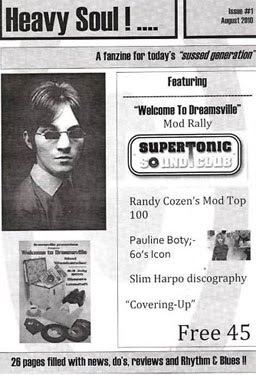
HEAVY SOUL! ISSUE 1


Is there a need for fanzines or are they simply a quaint throwback to pre-internet days? My hunch is like elsewhere in the publishing game it’s increasingly difficult to sell what people can get quicker, easier, and cost-free elsewhere so any fanzine will need to offer something different. Beat Scene, covering the beat generation, is a good example where I can’t think of an internet equivalent covering the ground it does in reviews, articles and interviews. Their website supports the magazine without duplicating it, making the printed version essential.

Throwing its 26 stapled A4 pages into the almost empty ring is Heavy Soul! - “A fanzine for today’s sussed generation”. One might call it a modzine. It has a big target on the cover and a random picture of Steve Marriott as clues. It costs £2.99 and another £1.50 postage and includes a free four track EP. The editor wrote on the Modculture forum he was “trying to get back to that authentic 80s/90s style of zine. Amateurish but readable”. I’d gladly take an enthusiastic amateur over a weary professional but thinking back to old zines of yore I wonder which ones acted as inspiration.

The best ones, even twenty five years later, stick in my memory. Extraordinary Sensations was a trailblazer both for content and opinion, Go-Go did an astonishing job in producing a monthly issue that pushed the generally accepted musical boundaries of the young moddybods, The In-Crowd was a blinking eyesore but covered every tin pot band in laudable detail, The Right Track made me laugh, and the production values and unique attitude of Hipster were outstanding. Then there were heaps of other simple cut and paste jobbies, now forgotten, that although crap at least had an undeniable passion in them. They were all very amateurish (bar Hipster) but did their best and acted as little central hubs of communication.

Does any of this apply to Heavy Soul!, you may ask. The fact I’ve built up to the answer suggests not and although I’m loathe to be too critical if I don’t offer some, hopefully constructive, balance no-one will and all you’ll read is “brilliant fanzine” comments on Modculture, when clearly it isn’t. It doesn’t come close to touching any of those attributes mentioned above and more importantly it stirs little passion or enthusiasm in its subject. Fanzines should be a labour of love, this looks like an ugly child born begrudging out of need. That need? For Rowed Out Records to offload its unsold stock.

One strong selling point is “our friends at Rowed Out Records have kindly donated one of their first and now collectable EPs”. Those “friends” feature quite a lot. Lots of advertising, promotional gumph and even a record review of “another storming release on the productive Rowed Out label”. Because, it seems, they are one and the same and Heavy Soul! is a convenient way to shift those “collectable” EPs (four current bands) that have been gathering dust for three years. I say “it seems” because the fanzine, incredibly, includes no contact details whatsoever. No name, no address, not even an e-mail. Who’d produce a mag and not put their name to it? Who’d not want people to get in touch? Bit weird. No editorial or introduction either. Odd. I’ve no problem with Rowed Out producing a fanzine; it makes good business sense, just no need to be so damn disingenuous and underhand about it. It could actually work well tying the two together. I’ve no idea how many copies they sell of their singles (low hundreds max) and I’ve never bought one before but would be more inclined to buy a fanzine with a free record than buy a single on its own and vice versa.

But, of course, that fanzine needs to have something to read in it (and something to say) and I’ve probably spent longer writing this review than any of the articles here. Heavy Soul! doesn’t say anything. It is mostly pages of filler, stolen filler at that. Two pages for Randy Cozens’ Mod Top 100. Oh Lordy, how many times has that been published over the last 31 years? It’s not relevant now, merely an old curio, mildly interesting, and yet it’s cut and pasted straight from a Modculture feature less than a year ago. Another page for DJ playlists, again lifted (uncredited) from Modculture a matter of weeks ago. Two pages about Pauline Boty. That’s more interesting, and it’s well written – it should be; it first appeared in the The Guardian. What about northern soul cover ups? The list is so ancient it’s totally pointless and looks suspiciously like something pinched from northern soul fanzine Soulful Kinda Music. Want a Slim Harpo discography? Use the internet. I’m paying for what I’ve read already here. Have I got mug written on my forehead? It’s lazy and insulting. A tick though, finally, for the review and photos of the recent Welcome To Dreamsville Mod Rally - a new piece (I think, I hope, I pray) by Keith Jones that gives a good sense of what the event was like. Hallelujah. More please. There are some single “reviews” but they’re so flimsy they read like adverts (bet they are) rather than genuine reviews. There’s a page plug for a Rowed Out band. Why not interview them instead? Write a feature? Fuck’s sake.

It isn’t 1985, 1995, or even 2005 any longer. It’s 2010 and the bar has been raised – by technology, by experience, by demand - things should be measured against that, especially if you’re charging increasingly hard earned money. Today’s “sussed generation” surely deserve better.

Heavy Soul! is available via eBay.
Modculture is available here.

Saturday, 10 July 2010

BEAT SCENE ISSUE 62


Charles Bukowski may be the cover star of the Beat Scene 62 but it’s the new nine page interview with Carolyn Cassady that steals the issue for me. She’s written and spoken many times about her husband Neal Cassady and lover Jack Kerouac but I’m never less than fascinated by their relationship. I still can’t grasp the hold Neal had over people – Carolyn in particular. Even his portrayal in On The Road isn’t flattering: a con-man and a rat who abandons a sick Jack in Mexico; and that’s without the bigamy and constant philandering she had to deal with. Maybe she was hip and I’m squarer than I’d care to admit.

Continuing the spouses theme, Richard Brautigan’s first wife Virginia Aste is also interviewed. There’s a good article about Kerouac and his time in Detroit with his first wife Edie Parker (who Carolyn memorably refers to as a weirdo and a nut case). Bukowski gets his coverage - reviews and extracts from a couple of newish books. Dan Fante writes about his father, John Fante, and fellow writers blacklisted by Hollywood during the 40s.

Loads of other stuff as usual within its 64 advert-free pages. Four pounds stirling.

www.beatscene.net

Sunday, 21 March 2010

BEAT SCENE ISSUE 61


It must be twenty years since I first bought Beat Scene issue 9 – with Charles Bukowski holding one of his cats on the cover – from Compendium Bookshop in Camden Town and have bought every one since. Now up to issue 61 and it keeps getting better. Where else would you find a twelve page piece about William Burroughs in Denmark?

Other articles include Burroughs and Drugs, Eddie Woods remembering Harold Norse and a tribute to Jim Carroll. Among the reviews are books by Dan Fante, Charles Bukowski, Knut Hamsun, and Michael McClure.

Loads of other stuff crammed in its 64 pages. Yours for a mere £4 at Beat Scene.

Wednesday, 3 February 2010

JOHN FANTE - A CONVERSATION WITH BEN PLEASANTS


“Fante was my god”. As the rule states no mention of John Fante is allowed without Bukowski’s quote, I’ll get it out the way now.

Fante’s 1939 Ask The Dust was one of those books that as soon as I read it I couldn’t spread the word quick enough. Every person I told or I bought a copy for loved it immediately and hunted out his other books, particularly those starring his alter-ego Arturo Bandini.

He was blind and nearly seventy by the time Ben Pleasants interviewed him in the late 1970s. Those interviews have remained unpublished, except for a small segment released last week as a Beat Scene Press chapbook, John Fante - A Conversation with Ben Pleasants. Naturally enough he talks about Ask The Dust, as well as reminiscing about his pal Willam Faulkner and F. Scott Fitzgerald’s handshake. There are no earth shattering revelations but it’s a nice little collectable addition to the Fante shelf.

John Fante – A Conversation with Ben Pleasants is published in an edition of 125 numbered copies by Beat Scene Press, priced £5.95 at beatscene

Thursday, 5 November 2009

BEAT SCENE NUMBER 60


The new season rolls in, and a new Beat Scene rolls off the press. This one is a bit special as it devotes every one of its 64 (advert free) pages to Jack Kerouac.

New articles on Jack’s hometown of Lowell; his brief trip to London; Neal Cassady’s first letter to Jack; an interview with girlfriend, and author of The Awakener, Helen Weaver; reprinted letters to and from John Clellon Holmes and Gary Snyder; a rejection letter for On The Road; reviews of new books and films; and much, much more.

There’s no magazine like it. It deserves your support. Subscribe at www.beatscene.net.

Thursday, 13 August 2009

BEAT SCENE ISSUE 59


It’s always a joyous moment each season when the latest Beat Scene hits the doormat. The summer edition is out now and stuffed with news and features on all your beat related characters and their literary and literal offspring.

Issue 59 includes big hitters Burroughs and Bukowski mixing it with less familiar names Kay Johnson and Allen Deloach; amongst the book reviews is Jan Kerouac: A Life In Memory which should make a fascinating read following the recent court case; an interview with my old goldfish’s namesake Herbert Huncke who talks candidly about drug addiction, prison and hooking up with the New York beat crowd; and much more.

I’ve one spare issue to give away to the first person who sticks their hand up. The rest head to www.beatscene.net

Sunday, 24 May 2009

BEAT SCENE


Issue number 58 of Beat Scene is out now for aficionados of the Beat Generation and their offspring.

Jack Kerouac features heavily, as does Gary Snyder, Lew Welch and Hunter S. Thompson. There’s a look at Joan Vollmer’s life before it ended with a bullet in the brain from hubby William Burroughs. It doesn’t though mention one of my favourite stories concerning the pair. According of Bill – and newspaper reports seem to back up his claim - he and Joan were drunk and decided to pull their car over to the side of the road, got out, and started fucking whilst son Billy sat on the back seat. Of all the mental images of Burroughs’ behaviour, a randy young man doing it with a woman isn’t one that immediately springs to mind.

The magazine may not be the most beautiful girl at the fair, and is overdue a makeover, but what she lacks in looks she makes up in heart and passion. It’s a labour of love by Kevin Ring who earns extra kudos for doggedly resisting the pressure to publish any articles on-line. If you want to read them, you’ll have to buy the printed version. With decent articles and a comprehensive round-up of new books and reprints, I suggest you do.

For subscription details and beat news: www.beatscene.net