Thursday, 7 October 2010

NATIONAL POETRY DAY: "PACIFIC TELEPHONE" by CHARLES BUKOWSKI


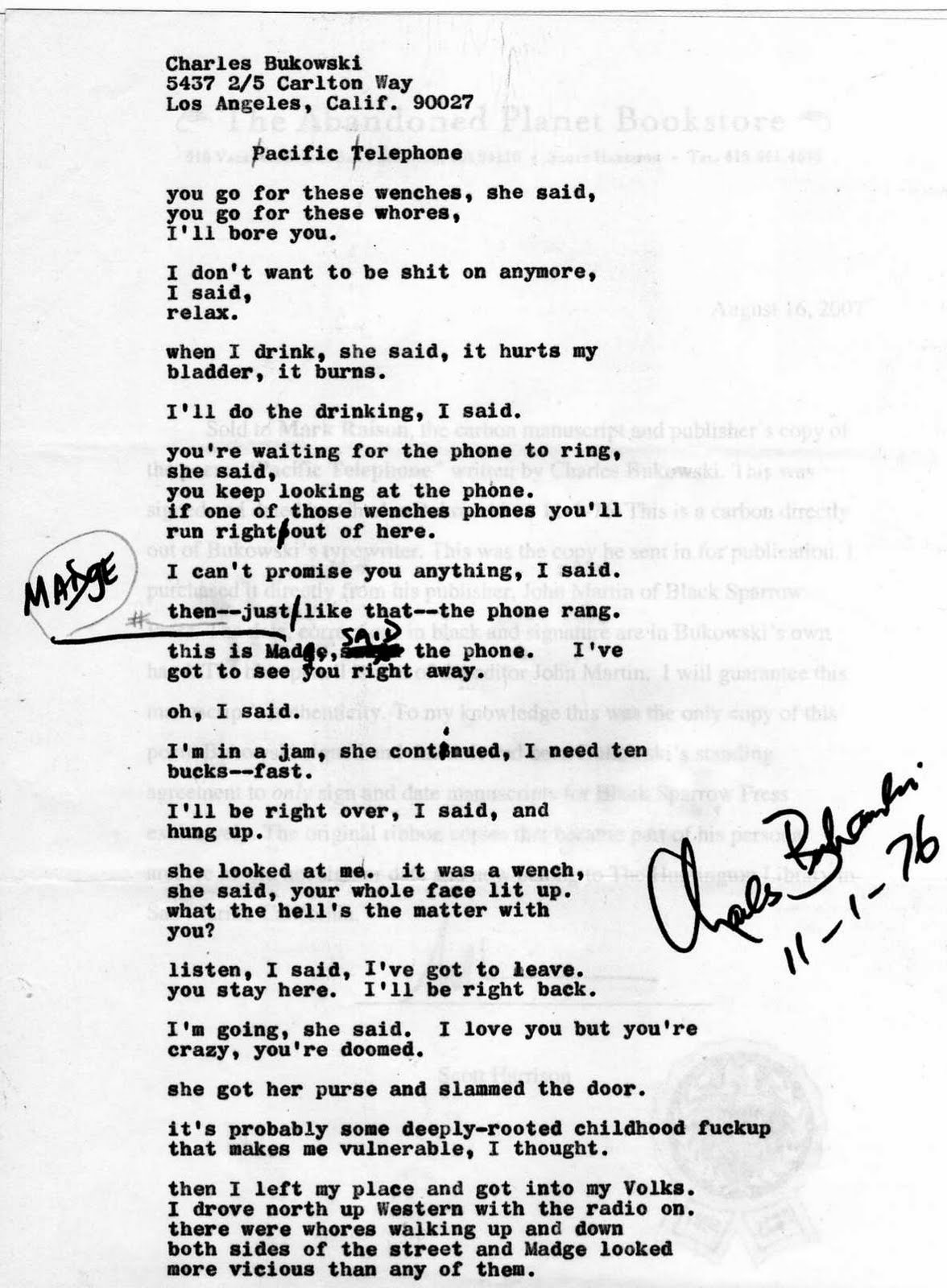
Today, apparently, is National Poetry Day. I’ve no idea what it involves nor do I care, but it's a good excuse to share one of my most treasured possessions with you that hangs proudly from the marbled walls of Monkey Mansions.

Above (click on it) is the original manuscript straight out of Charles Bukowski’s typewriter of “Pacific Telephone”. As you can see he wrote it on 1st November 1976, signed it, and posted it to his publisher John Martin at Black Sparrow Press. It appeared in Love Is A Dog From Hell the following year. The black pen marks are by Bukowski and the pencil marks by Martin.

It is so typically Bukowski and you can hear him so clearly reading in that slow lazy drawl and then adopting the whiney voice he used whenever speaking on behalf of the women in his life.

Bet old Hank would’ve loved National Poetry Day…

Wednesday, 6 October 2010

Sunday, 3 October 2010

RICHARD by BEN MYERS


“Most of my heroes don’t appear on no stamps.” Someone (Chuck D) said it, the Manic Street Preachers quoted it, and I pinched it. It’s a recurring theme.

I wouldn’t say I’ve any heroes as such but I wouldn’t deny The Jam, and Paul Weller in particular, musically and sartorially shaped my early teenage years and a decade later the Manic Street Preachers, and Richey Edwards in particular, had an equally profound and lasting effect ideologically and culturally.

The streets were covered with snow in January 1991 when I bought, unheard, the Heavenly 12 inch of “Motown Junk”. Time hasn’t diminished the thrill and rush of that garbled punk urgency which flew acid in the face of everything around it, then and now. It’s difficult for newcomers now with the Manics far removed from the mess of eyeliner and spray paint that first dazzled from the pages of the NME spouting off about William Burroughs, Karl Marx and Harold Pinter to believe how vital and exhilarating they were in an flimsy era of post-baggy "we've always had a dance element to our music" desperation and faceless shoegazing dullness. The Manics were a fascinating, intelligent, well read, educated, cynical, unfashionable, working class band kicking against the pricks, yet slowly – and frustratingly – unraveled as often willfully subservient and compromising.

Ben Myers’ Richard tells two stories in parallel. The first recounts the story of four insular school friends from a Welsh mining town that became the Manic Street Preachers who invited and provoked hostility and adoration in equal measures. Edwards, with little to no musical ability being enlisted because he was their best friend, driver, looked fantastic, balanced the symmetry, could write lyrics and be their Minister of Information a la Public Enemy’s Professor Griff. It proved a smart move but one that came at a price. There’s little in Myers’ imagining to cause too much indignation from Richey acolytes, as it effectively blends established “fact” with Richey’s well documented sense of worthlessness. After only selling a handful of their first homemade single Richey was already saying “There is more self hate in this band than anyone can realise. We hate ourselves totally”. Yeah, yeah, nice quote mate, makes good copy for the music press, play the game. Prove it they said.

The second, potentially more difficult to accept book, is the one told in Richey’s voice from the time he disappeared from the Embassy Hotel in 1995 never to be seen again. Myers uses the few alleged sightings as stepping stones to construct a version of events and a version of what could have been going through his mind. How would he know? Well, he doesn’t, does he? The book jacket pointedly says Richard - A Novel, not Richey Edwards - The Unauthorised Biography. It paints a distressed Richard driving on autopilot back to Wales, trampling the hillside, seeking solitude and release from the taunting voices in his head telling him what an insignificant, useless coward he is. Kurt Cobain, he proved it. He was 4 Real.

Myers was always going to court controversy with this (“how very dare he?”) and the technique has been done better before (David Peace’s The Damned United) but I managed to easily separate fact from fiction. Richey fans should be an intelligent bunch but that didn’t stop the clatter of protest before publication. If somebody had done the same to a personal friend of mine my instinct would be to want their severed hand on a stick but I didn’t know Richey; I only canonized my own interpretation of him. The interpretation based on his interviews and lyrics so I struggled through the first third of this book as I couldn’t hear Richey’s voice. The words attributed to him are at times simple and clichéd, as is some of the text, and not as eloquent and as carefully measured as I’d expect. But that slowly sinks away and the comparisons drift apart. I stopped reading it as an account dictated via Doris Stokes and started to appreciate it as a novel in its own right. It’s an increasingly uncomfortable and terribly sad read (and I’m certain no bundle of joy to write) but its contemplation on misery and confusion, alienation and despair, self loathing and suicide are surely food and drink for followers of Richard James Edwards.

Richard by Ben Myers is published by Picador, priced £12.99.

Friday, 1 October 2010

MAVIS STAPLES - "YOU ARE NOT ALONE" (2010)

The magnificent Mavis Staples has a new album out. It’s mighty fine, as is this acoustic version of the title track.

Tuesday, 28 September 2010

SHAFT with RICHARD ROUNDTREE IN CONVERSATION AT THE NFT


“Where you going Shaft?” asks honky cop to the private investigator out on the freezing New York sidewalk. “To get laid. Where you going?” And with an exaggerated laugh he saunters off leaving said cop looking useless and impotent.

It’s a great exchange and one of many in a film I’ve not seen for so long I’d forgotten how good it is. So it was doubly cool not only to see it at the NFT on Sunday, but for John Shaft, actor Richard Roundtree, to be there too.

Can you dig it?

Gone is the immaculate fro, gone is the bushy moustache, gone is the leather trench coat, and most definitely gone are the ball breaking black leather strides, but Richard Roundtree is still the man. Albeit a 68 year old man in a conservative blue blazer over a canary yellow v-neck sweater. But there’s enough in his chat with DJ and presenter Iyare Igiehorn to let you know he still ain’t a dude to be messed with. For well over an hour he’s happy to yak about the Shaft films but when the topics stray into more personal or touchy areas he stays resolutely tight lipped.

He starts by explaining how he came to play the role: he had done a little theatre acting he was mainly employed as a model but put in for the role anyway. During an interview with photographer/writer turned producer Gordon Parks, Parks puffed on his cigar and pointed to an advert in a magazine on his desk. “We want somebody who looks like that”. That somebody was Roundtree himself. Parks gave him his break and throughout the interview Roundtree heaps mountains of praise on a man that clearly had a huge influence on not just his work but his life as well. One audience member later rates Parks up there with Duke Ellington and Paul Robeson in the pantheons of great 20th Century black cultural figures.

Igiehorn, who refreshingly for this type of event, gallantly tries to stick to fan type questions – rather than technical filmmaking questions – asks how he dealt with suddenly being an unexpected star after the huge success of Shaft in 1971. Roundtree thinks carefully. “I didn’t have to use toilet paper. You know what I’m saying?”. I’m thinking he was such a big cheese he had bitches wipe his hairless butt (more of that later) but he was trying to politely say he believed the hype and thought his shit didn’t stink.

Who’s the black private dick that’s a sex machine to all the chicks?

Without using the words Igiehorn tries to ask about the superstar lifestyle: the parties, the women, the drugs. Roundtree is having none of it. “The 70s were great” he says. That’s it. “Come on man, you can’t leave it at that?” But he does. “Lean on him” shouts someone. “You want me to lean on Shaft?” Still no dice. Attempts to extract juicy gossip about likes of Pam Grier are met with an impenetrable silence and a steely look.

They say this cat Shaft is bad mother –

We do though get a glimmer into one party though, held by Miles Davis. “Good job”, says Miles, “but you gotta learn to say motherfucker”.

Shut your mouth.

A fight scene from Shaft’s Big Score (1972) is shown, as is a bonkers scene from Shaft In Africa (1973) where a naked Shaft waking up next to a horse and then – still naked – engages in a spot of stick fighting before burying himself in sand. “What did you think when you read that in the script?” he’s asked. Roundtree doesn’t really answer but does say that Shaft In Africa is his favourite Shaft film as it was only then he felt comfortable with the role. And by the look of it comfortable prancing around waving his big stick in the air; although he had no idea his daughter’s classmates would discover the film years later.

The thorny issue of the blaxploitation genre – its portrayal of pimps, junkies and whores received negative vibes from within the black community - is touched upon and Roundtree how he’s met people in Mississippi and beyond who’ve told him how empowering the films have been to them and how he gets angry when people talk about exploitation. Watching Shaft again and seeing such a strong, cool, no nonsense, intelligent black man in a leading role you can see his point. And as Igiehorn remarks “it’s a movie where the black guy lives to the end!”

An audience question about the short lived TV series of Shaft is met with an obvious understatement of “I was not overly enamoured with it” and the Samuel L. Jackson remake received equally short thrift “needless to say I was underwhelmed”. Although he didn’t quite say it, it was apparent he was upset Jackson got the gig instead of him, which contrasted with Isaac Hayes’s reaction when he thought he’d get the original Shaft role but was still the “consummate gentleman” and such a “mellow human being”.

After a career that includes eight pages of an acting CV, Roundtree is forever going to be known as Shaft and expresses some regret almost all his subsequent roles have been as authority figures (not hard to see why), and leaves with the line “sometimes you just got to ride the horse in the direction it’s going”.

Damn right.
Sunday, 26 September 2010

SEPTEMBER PLAYLIST


For September gurls and boys.

1. Porgy and the Monarchs – “If It’s For Real” (1965)
Not much seems to be known about Porgy and the Monarchs but a listen to the brush then swish of the strings, the empty room acoustics, the tearful atmosphere, the consoling harmonies, the impeccable arrangement, the drum clicks like footsteps walking in to the lonely night, the heartache and the heartbreak, and it tells you all you need to know.

2. Bo Diddley – “Ooh Baby” (1966)
What a groove.

3. July – “The Way” (1968)
Not the album version by these UK psychsters but the even freakier sitar molesting pots and pans version on the flip of “Hello, Who’s There?”

4. The Staple Singers – “You’ve Got To Earn It” (1971)
Horns ‘n’ harmonica, flute, the kitchen sink and some typically right-on fist clenching positivity are thrown in to this not-much-like-the-original Tempts number by the fabulous Staples.

5. Pigbag – “Papa’s Got A Brand New Pigbag” (1981)
Let’s have a look at Queen’s Park Rangers’ scores so far this season: 4-0, 3-0, 2-0, 2-2, 3-0, 3-0, 2-0, 3-0. All together now: “Dood dood, dood-dod, HOOPS! Dood dood, dooo-doo/ Dood- dood, dood-dod, HOOPS! Dood dood, dooo-doo”.

6. The Black Crowes – “She Talks To Angels” (1990)
Long ago and worlds apart I was sat in a Vegas bar and told I looked like Chris Robinson. I didn’t but it made my night.

7. Race Horses – “Cake” (2009)
Watch the video on YouTube, then come back and thank me.

8. Isobel Campbell and Mark Lanegan – “No Place To Fall” (2010)
Hawk covers much ground including a crafty reworking of Bettye LaVette’s “Let Me Down Easy” (“Come Undone”), some spiky blues (“Get Behind Me”) but the highlight is the graceful folk/country/soul of “No Place To Fall”.

9. The Black Angels – “Telephone” (2010)
Phosphene Dream finds the Angels cutting back on the fat to show a leaner, meaner, laying off the munchies side. It’s still dense with heavy stoner rock but the load is lightened with a couple of blasts of twanging garage punk with Barrettesque breaks.

10. The Crookes – “Backstreet Lovers” (2010)
Their Smiths-scented new 45 won’t change anyone’s life but it bobs along pleasantly enough.

Tuesday, 21 September 2010

SICK CITY by TONY O'NEILL


When a chap named The Hammer appears in Tony O’Neill’s new novel you immediately dread how he earned such a moniker. It only takes a couple of pages to discover it’s on account of the shape of his fourteen inch todger which he uses as the template for a hand crafted, monogrammed dildo that’s shoved so far up a young man’s arse it gets stuck inside him, kills him, and has to be gruesomely retrieved before the body is disposed of.

Sick City follows the degenerate junkie theme of previous novels Digging The Vein and Down and Out On Murder Mile but it’s less overtly personal and deviates, and expands upon those, by moving away from first person to a third person narrative, giving O’Neill ample scope to create a vast cast of increasingly grotesque characters, which he does with obvious relish. This is a writer letting loose and enjoying himself. The Hammer dildo passage (if you excuse the pun) is but one of many wickedly funny moments amid the scuzzy world of sex and drugs that equalizes LA junkies and whores with Hollywood execs, TV doctors and police chiefs.

The story centers on bereaved faggot Jeffrey and shittypants outcast Randal’s not unreasonable plan to sell a Hollywood sex tape (including Steve McQueen giving a portion to Sharon Tate and Mama Cass…) to the highest bidder and thus getting clean, straight and living happily ever after. Easy as that. But on their trail comes Pat, a psychopathic speed freak with – in a nod to that other American Psycho – a Phil Collins fixation who thinks nothing of pulling off nipples with pliers to the sound of Phil’s Greatest Hits.

Sick City’s vivid cinematic quality begs it to be made into a film. Whoever gets the screenplay gig will have a piss easy job, it’s all here already. As is Primal Scream’s soundtrack.

Sick City by Tony O’Neill is published by Harper Perennial, priced $13.99.